Estonian Startup Awards 2025 - The Winners, The Nominees, And A Rocketing Ecosystem
The annual overview by Kadri Barclay, Ragnar Sass,
and the organising team of Estonian Startup Awards
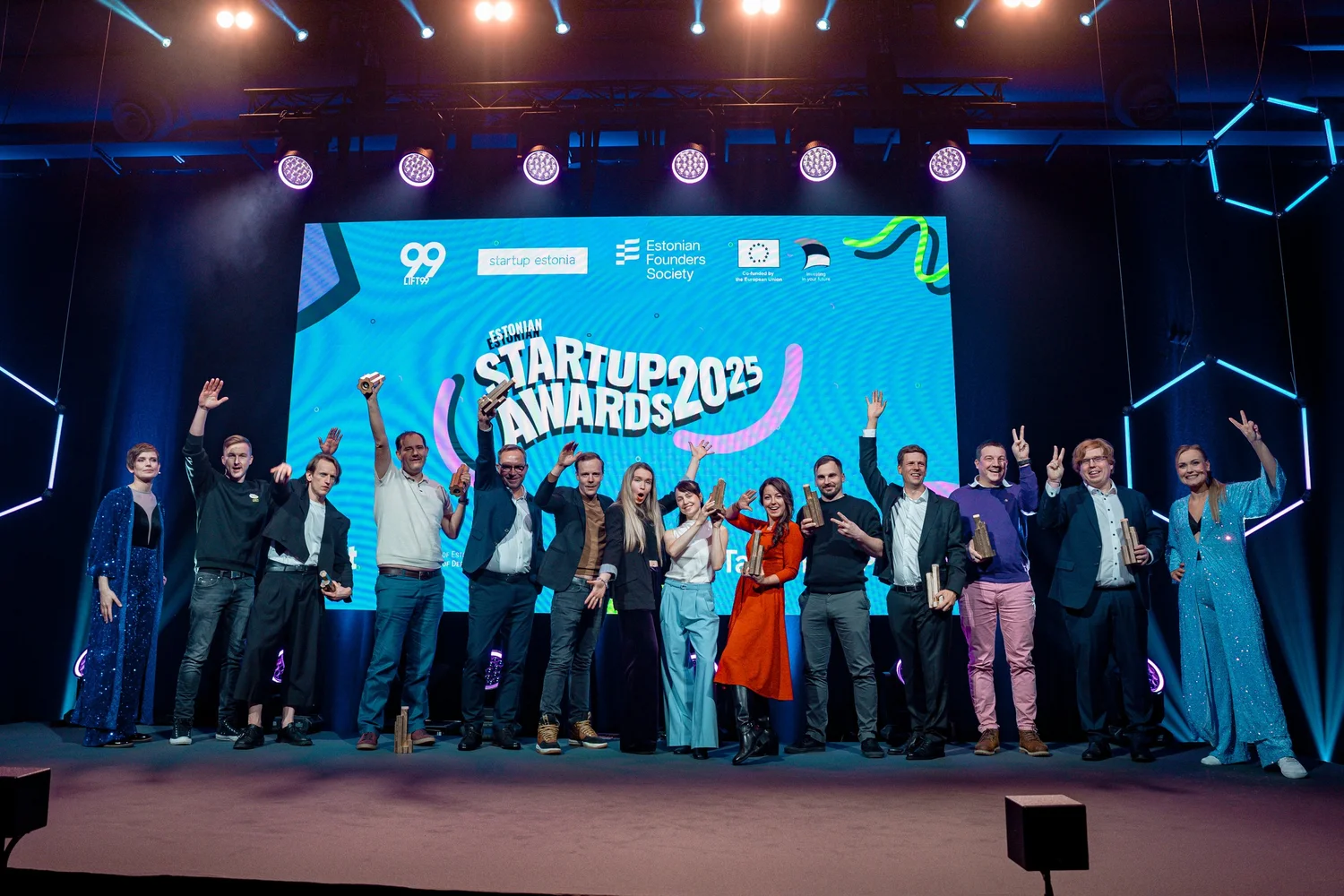
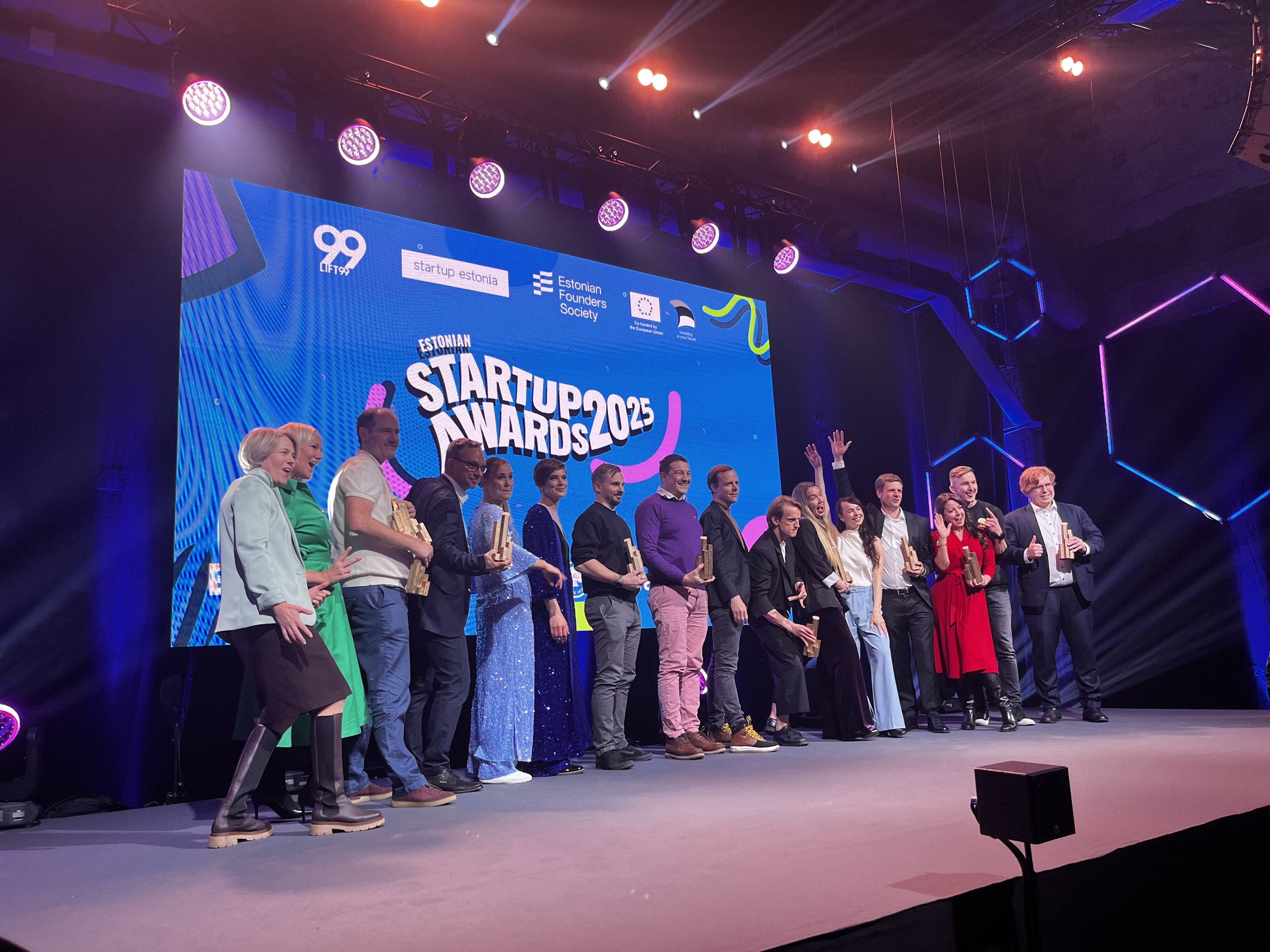
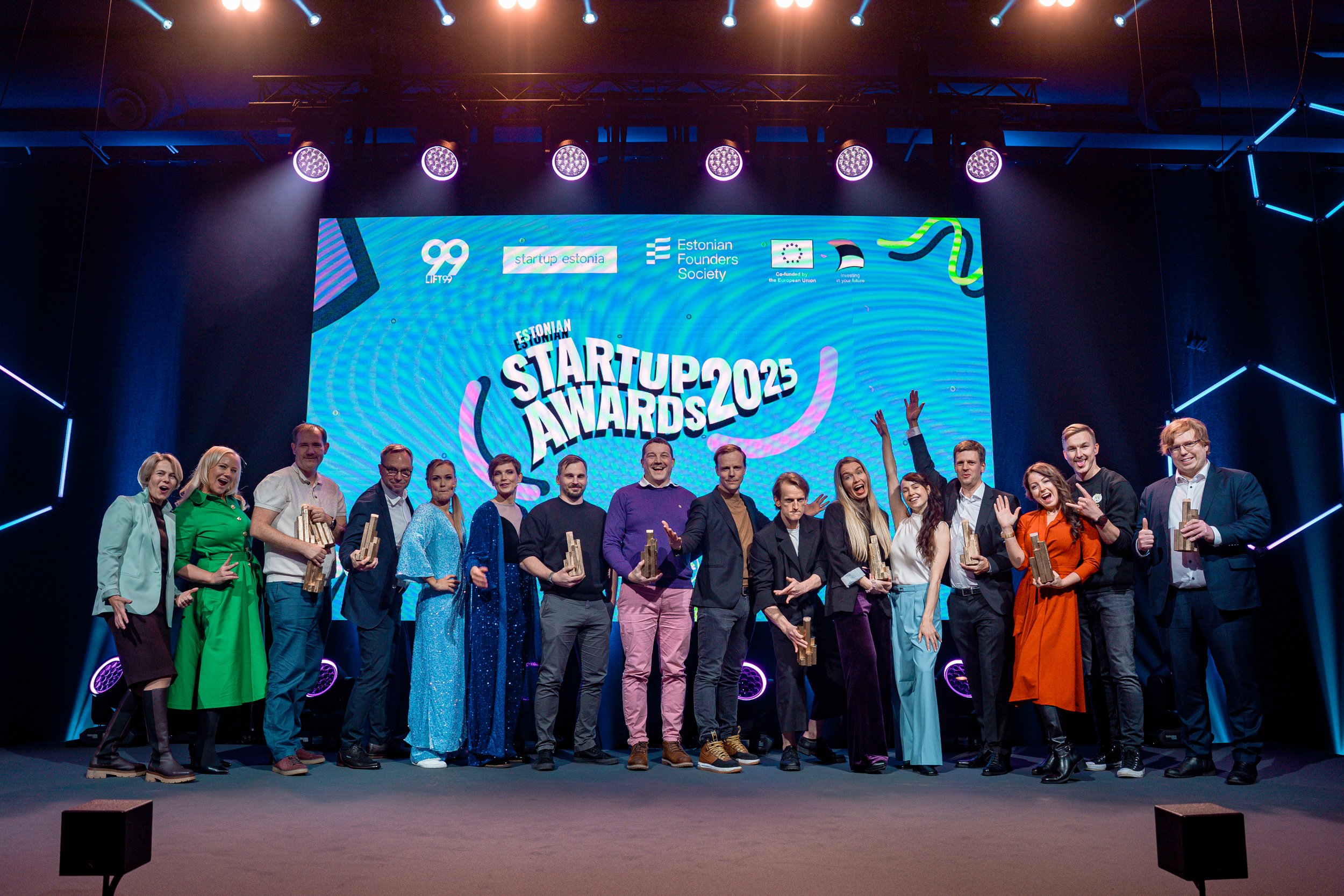
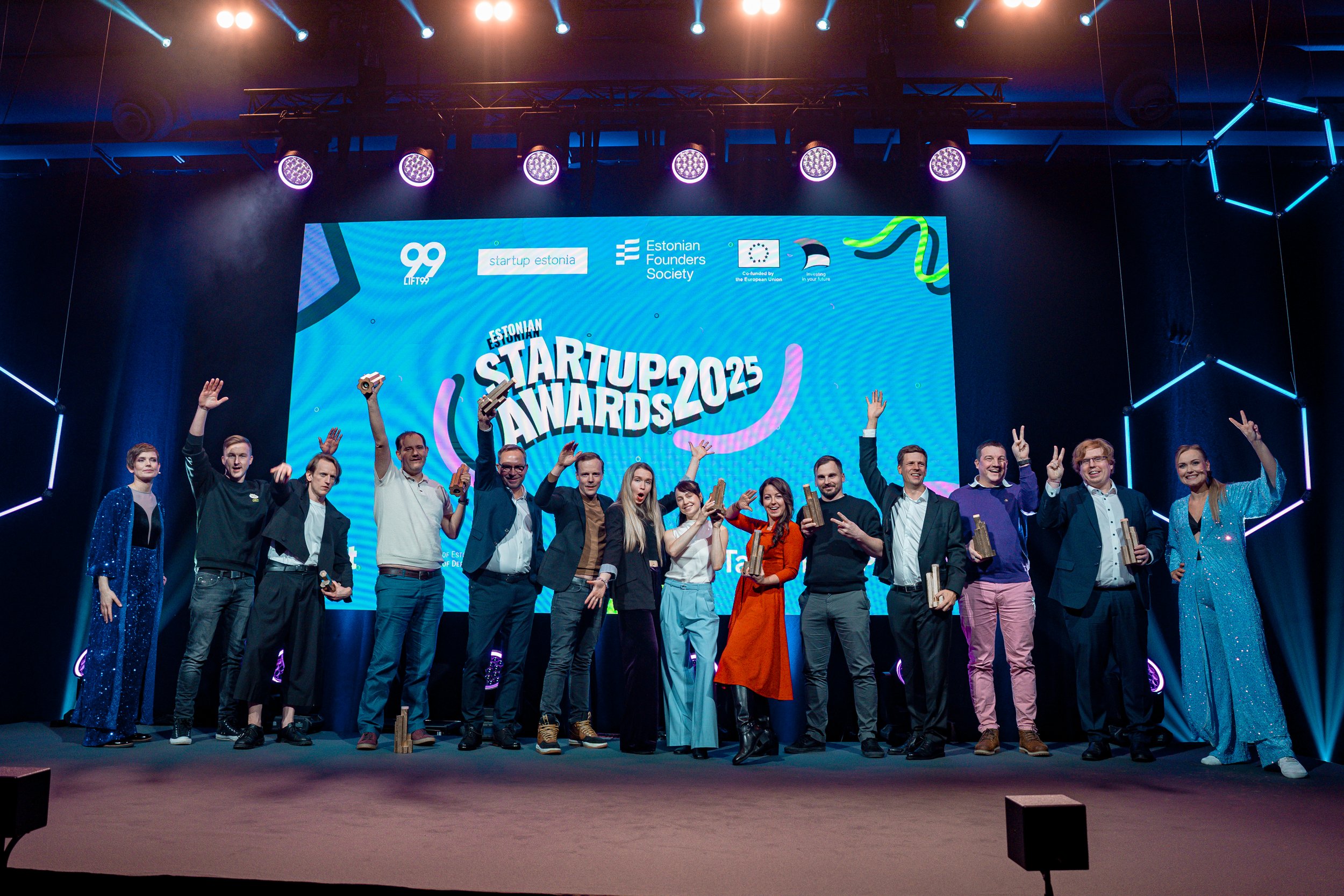
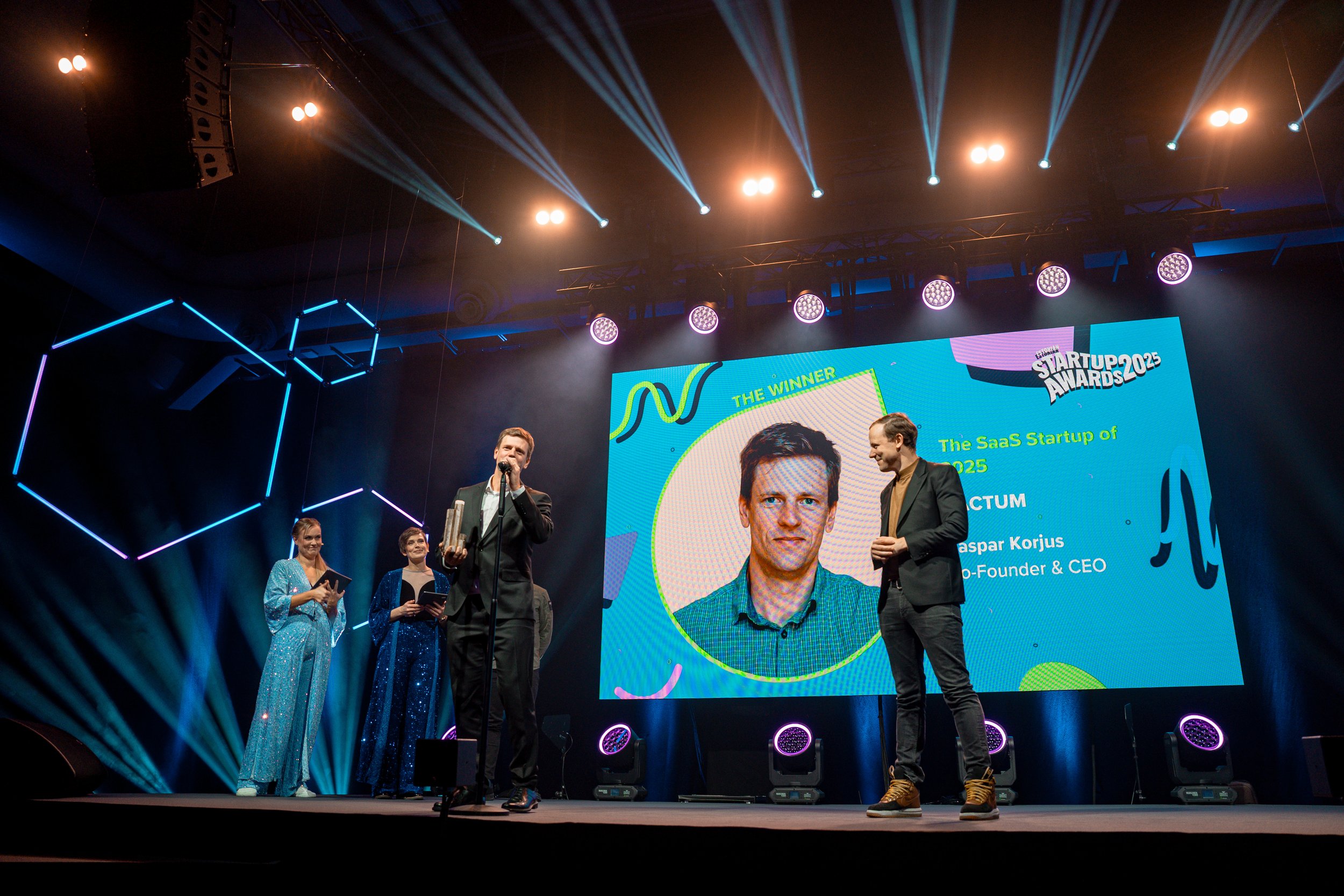
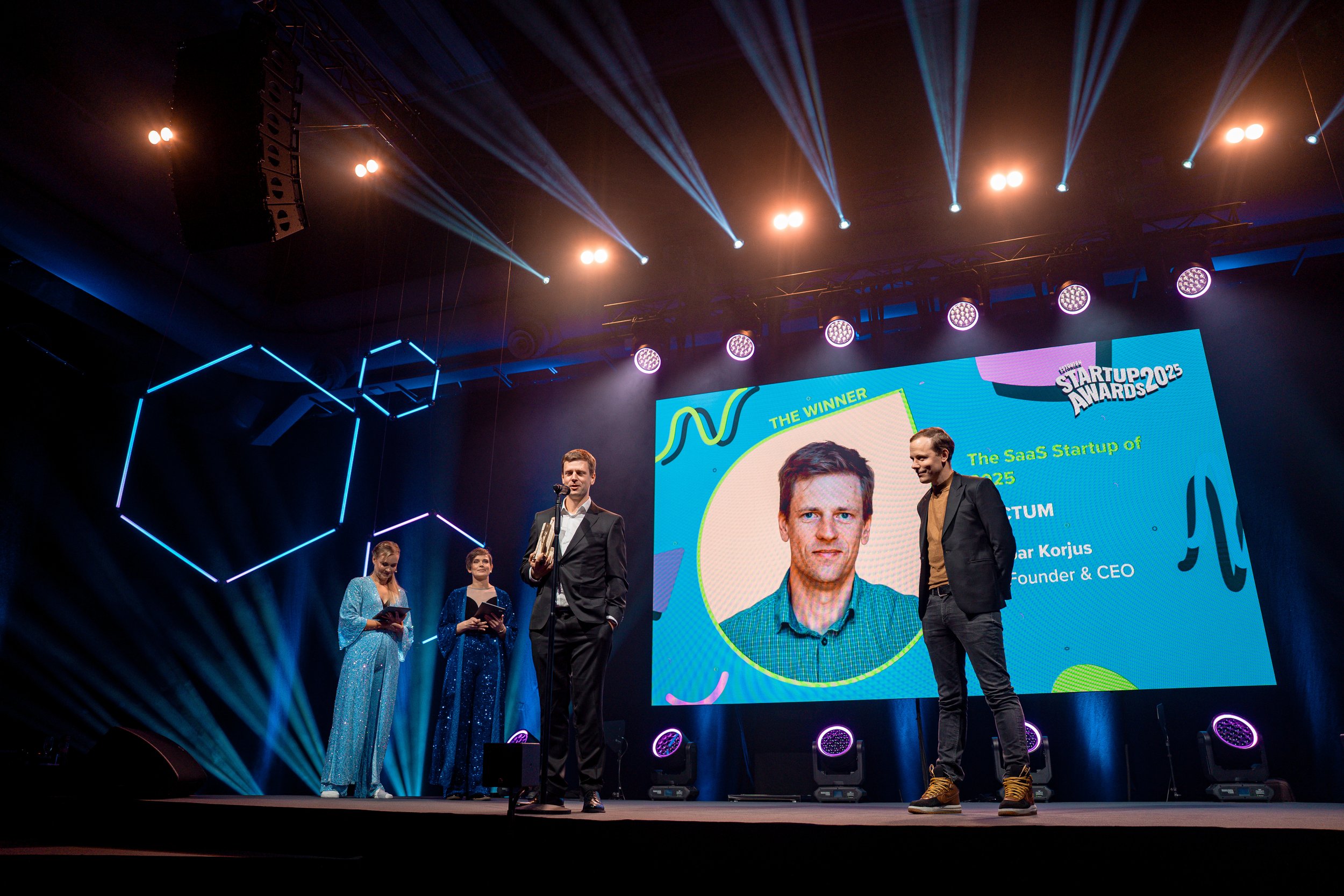
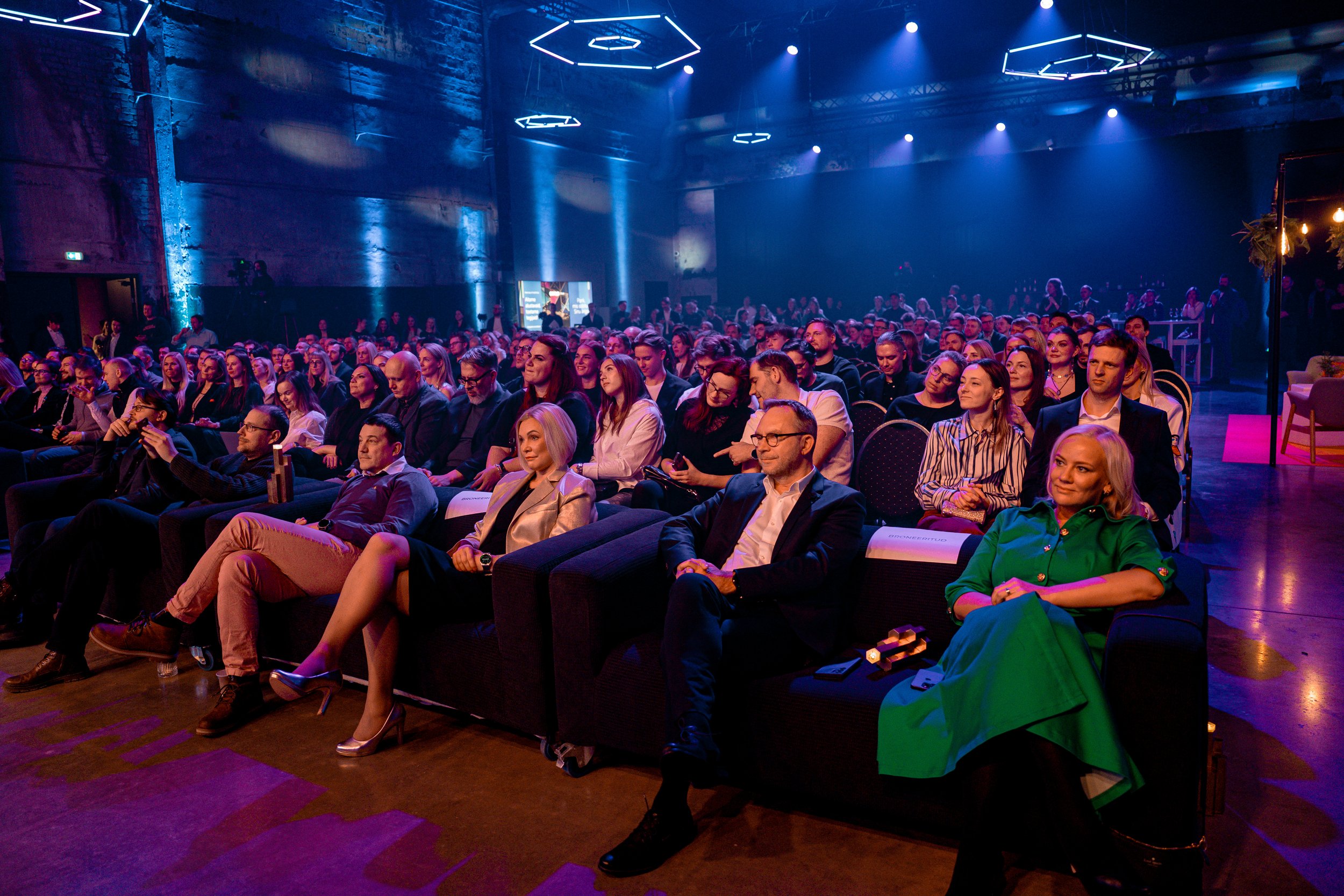
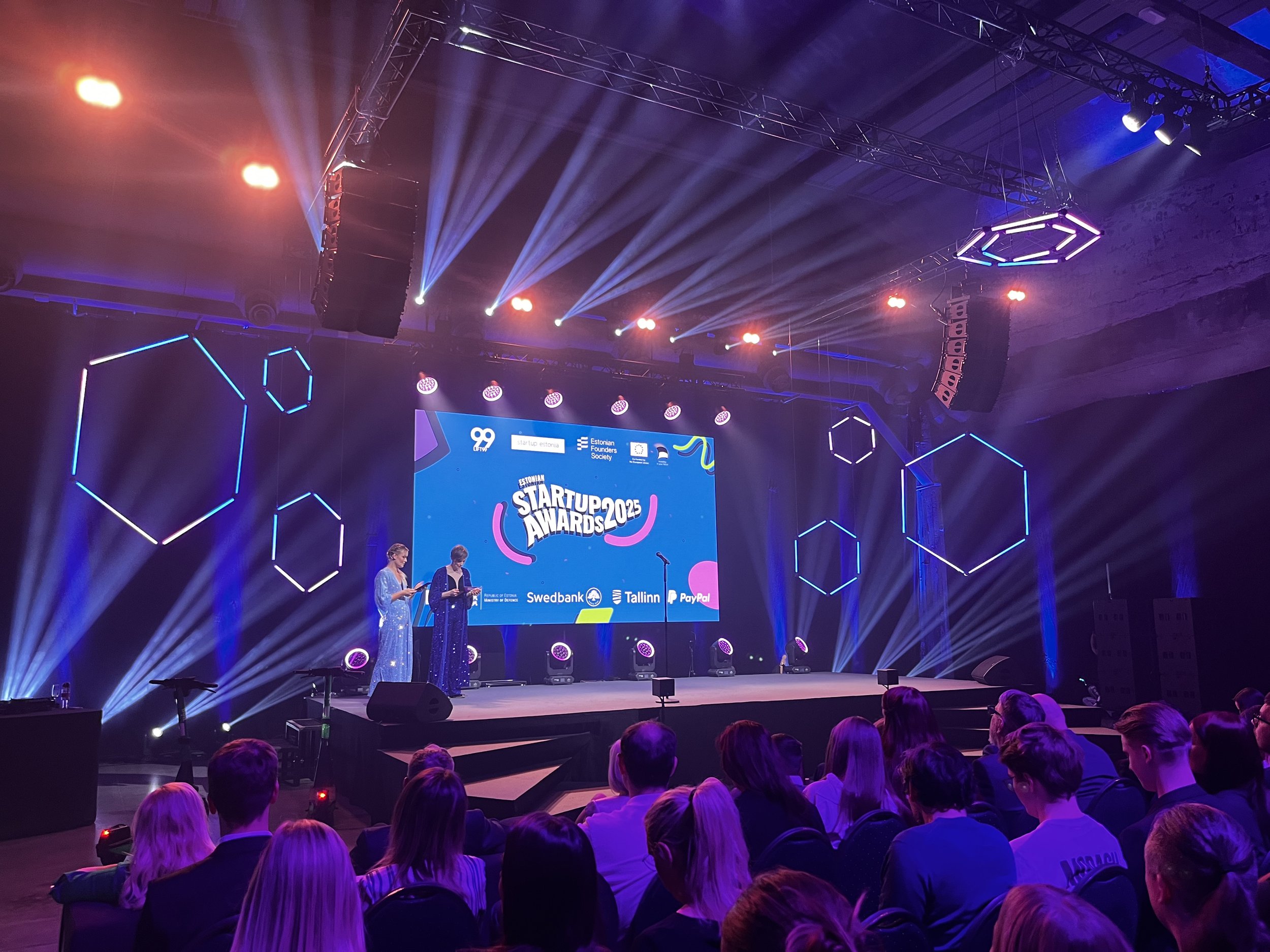
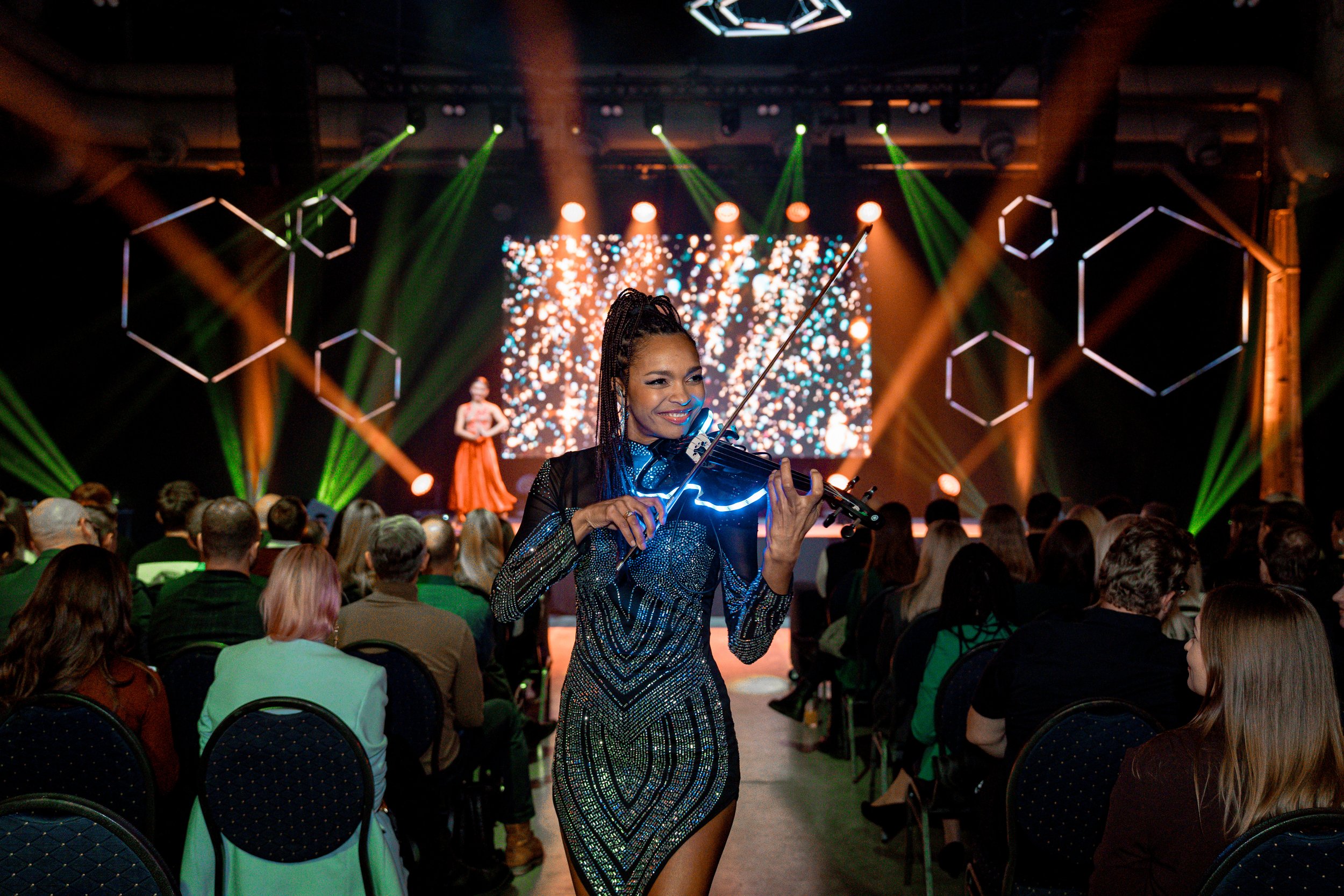
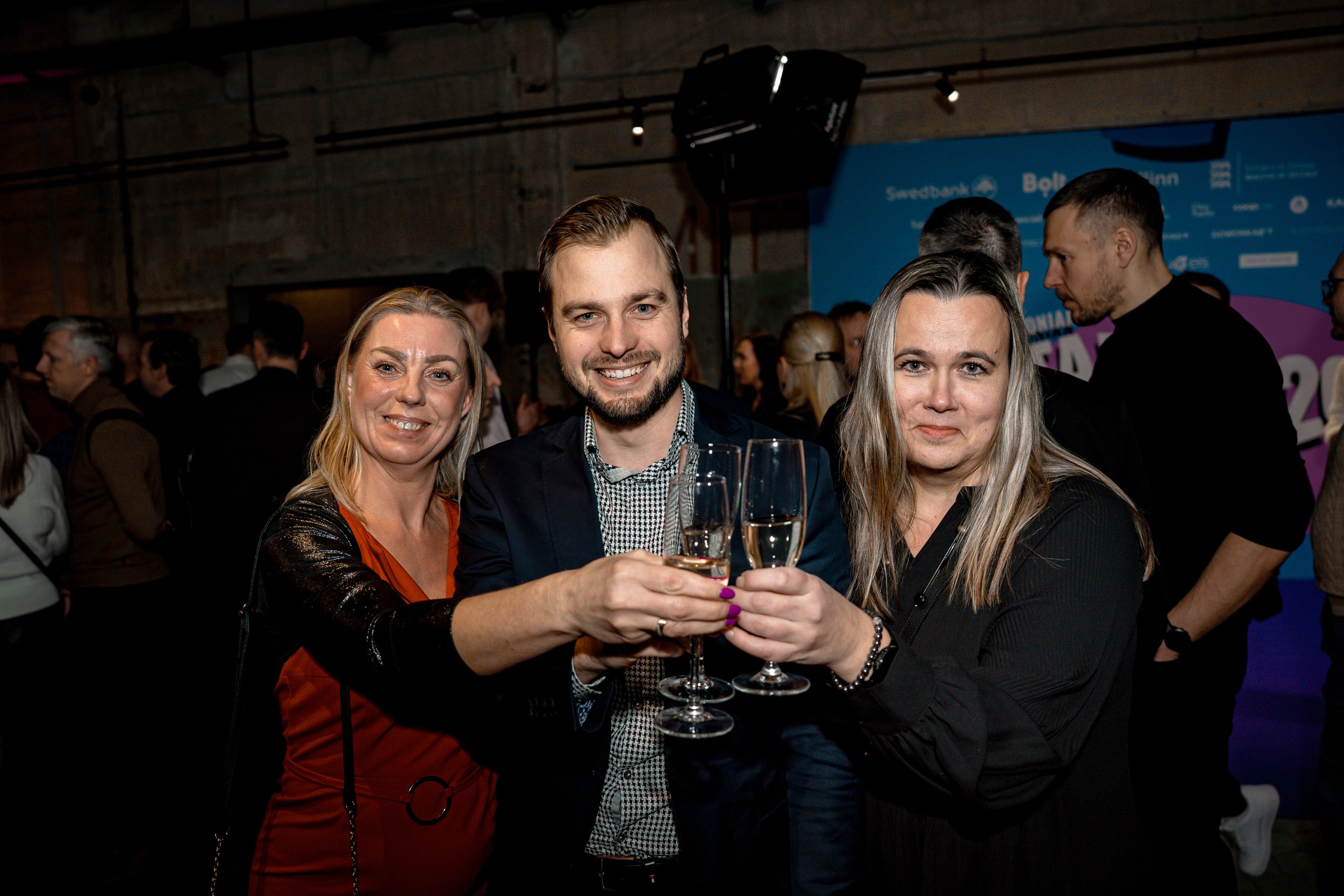
On the night of January 22, 2026, the 7th edition of Estonian Startup Awards once again gathered over 400 founders and community-supporters to the Nobel hall in Noblessner. The awards were presented in a total of 11 categories, with DeepTech, AI, and DefenceTech shaking the floor, as we took a final look on 2025 and the celebrated the most recent wins of the startup ecosystem in Estonia.
Read on to find out who were the 100+ nominees shortlisted this year, and more importantly - who took home the awards!
PS. Eager to see all the photos of Estonian Startup Awards 2025? Dive into the official photo gallery. You may also wish to check out our aftermovie - it’s got vibes! And if you’re really commited, the whole gala can be re-watched here. Enjoy!
/

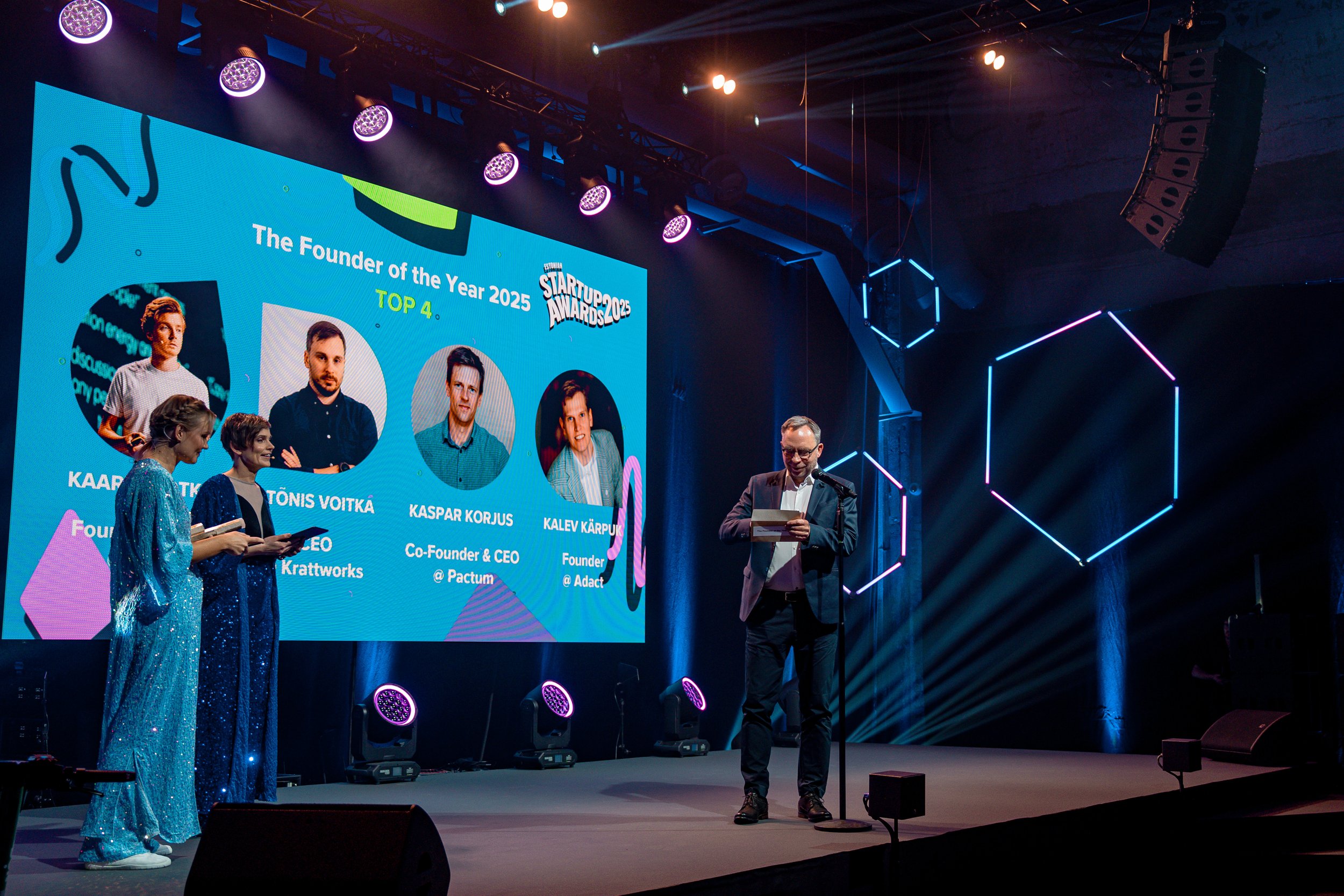
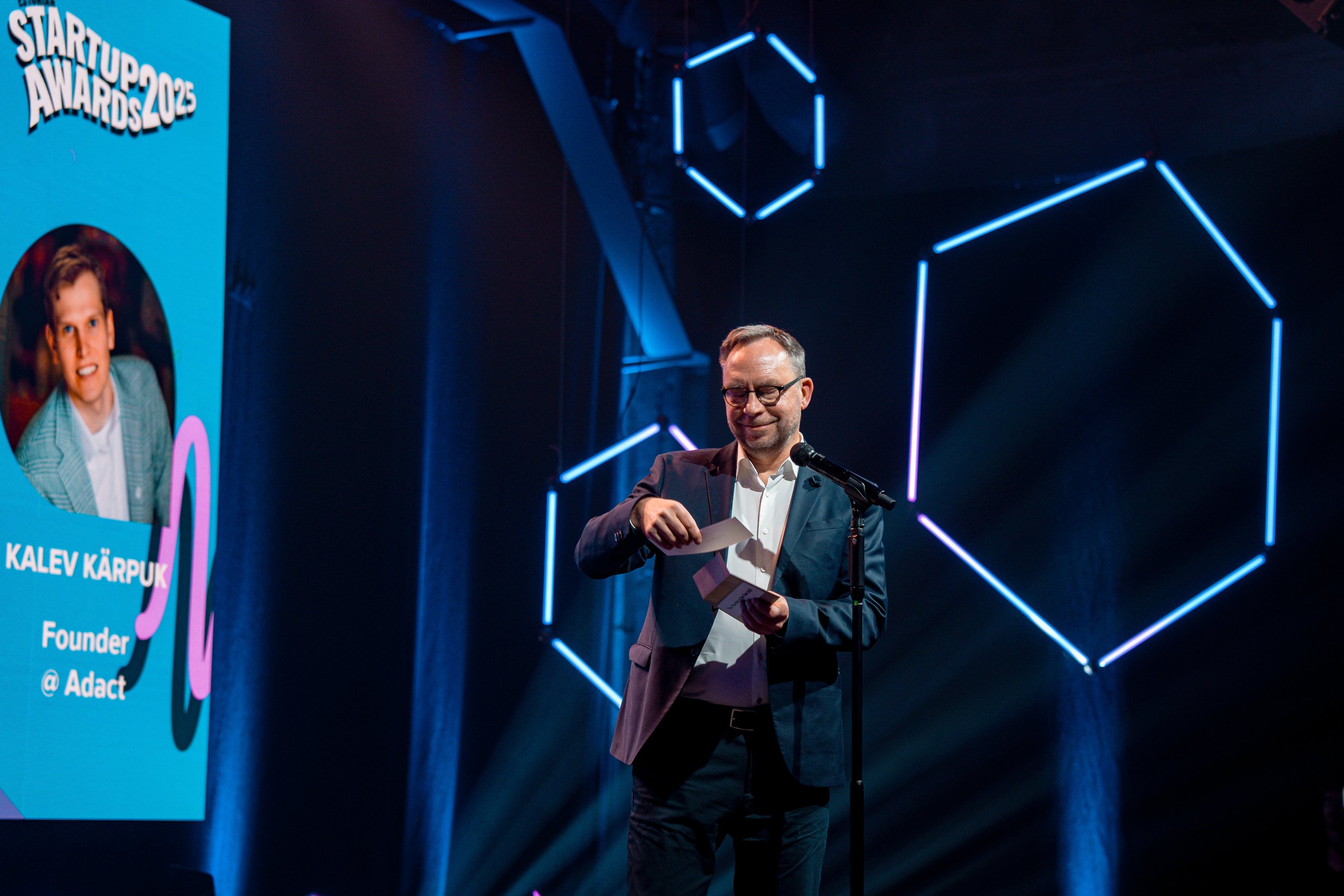
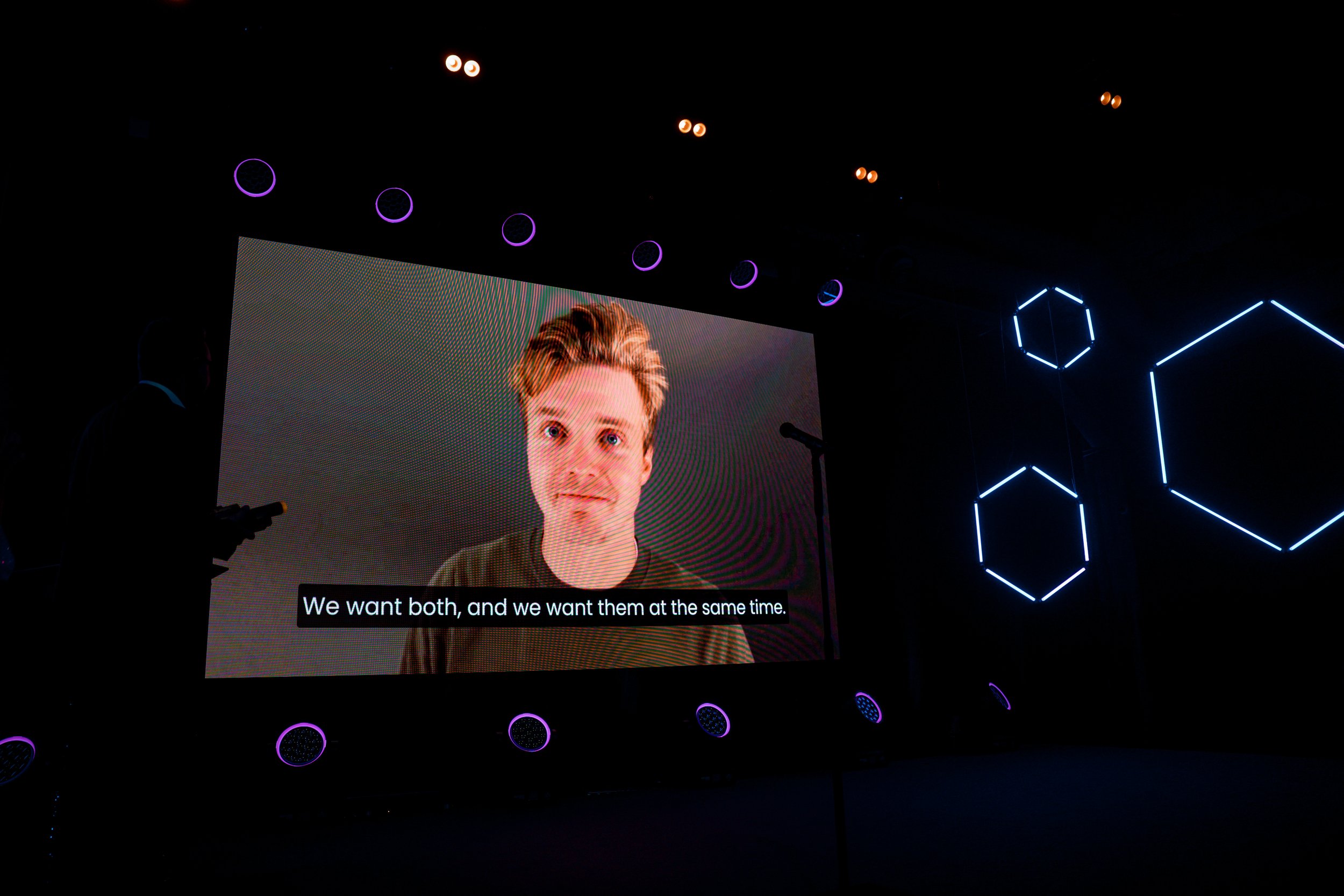
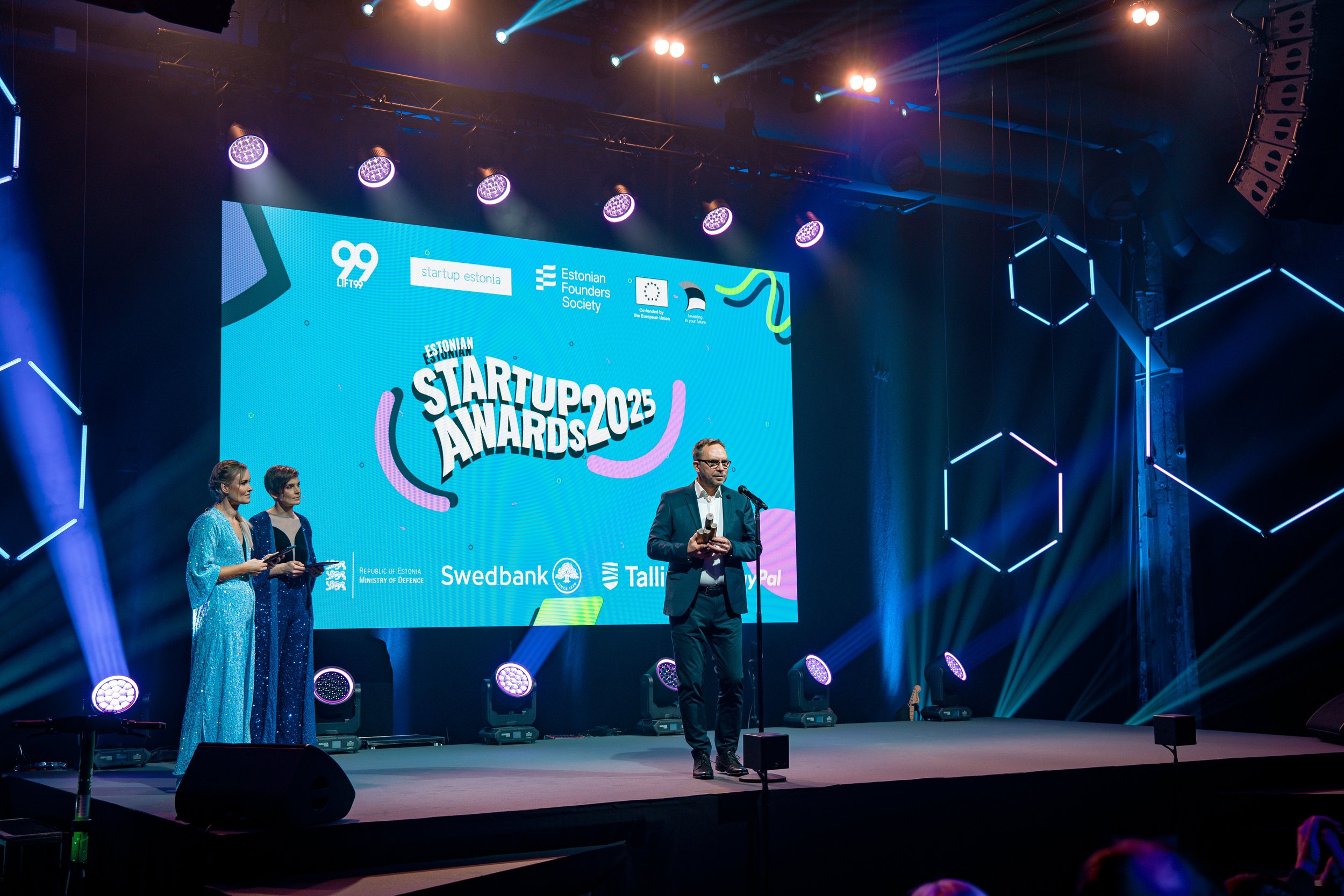
Finding The Winners
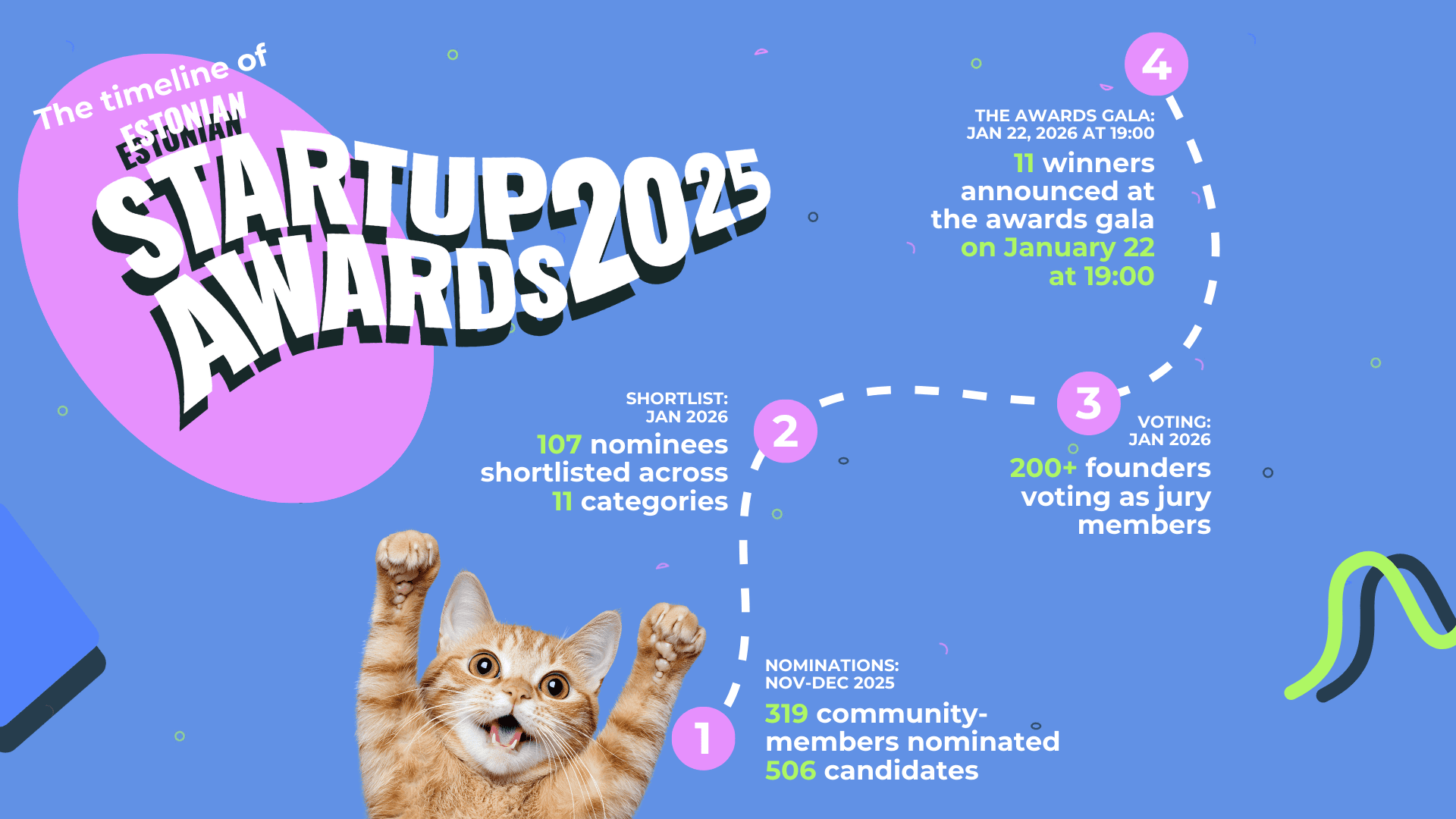
As traditional, the public nomination round kicked off in November 2025. The first record of the year was already set when the startup community at large presented 506(!) names/nominees to be considered for the awards. That’s a significant growth from previous nomination rounds, demonstrating the vitality and maturity of the Estonian startup community after the previous years of crises and challenges. We’re on a good track!
After careful consideration - digging into the detaild, statistics and growth-data with the help of the organizing team from Startup Estonia, Estonian Founders Society and LIFT99 - 107 candidates made it to the shortlist and were listed across 11 categories of Estonian Startup Awards 2025.
Next step - voting! We’re immensly grateful for the efforts of our jury - the 240 founders (thanks to the collaborative efforts of Estonian Founders Society and Startup Estonia) who cast a vote, thus helping to determine the winners in each category. Because who else would know better what it takes to lead a startup to success than a fellow founder?!
It’s interesting to note that in 2025 we saw a remarkable number of ties and close calls - in a total of 3 categories we are presenting the top 4, instead of the top 3! Sometimes 1 one vote can indeed make a big difference! And yet, there were other categories where the winner emerged by a landslide, leading others with a solid 40+ vote count.
Scroll on to find out which 6 startups took home the buzzing awards on January 22, whose achievements landed them in top 10 this time… and what the results say about the state of the Estonian startup ecosystem in 2025 (and beyond)!
What Happened In 2025?
So - what’s the gist of it? 2025 has 2 main rockstars.
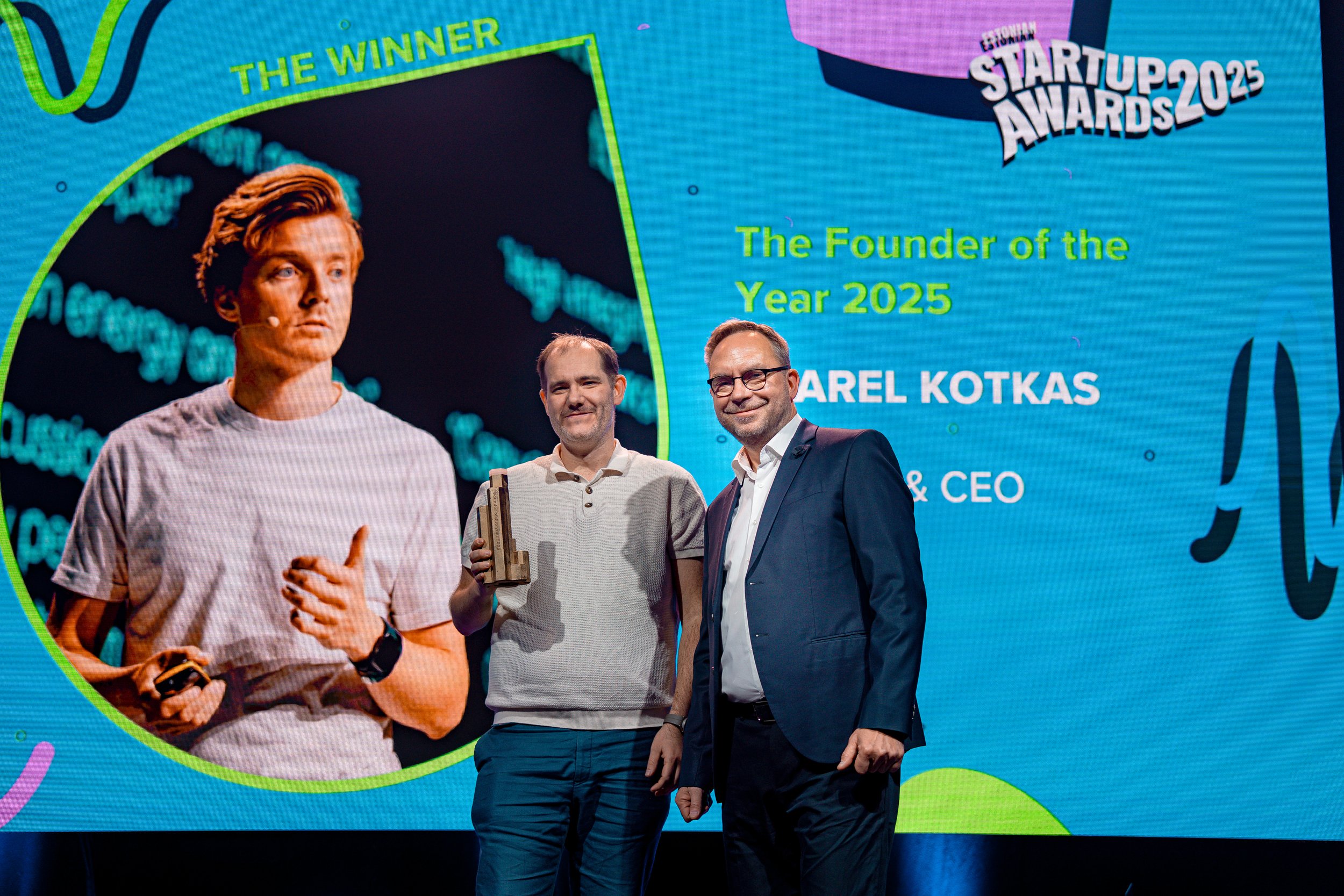
Kaarel Kotkas and Veriff made a clean sweep with 3 wins, including the Founder of the Year and Revenue Hack of the Year trophies; and even landed in the top in some categories that it did not win (maybe next time, Kaarel, mh?). Revenue-wise, Veriff stood mountains above the rest - to the point where over-communicating it would feel redundant. Impressive.
Kaarel’s win marks a rare and deserved return to the top after already winning the same category almost half a decade ago - proof that sustained excellence is possible. What’s remarkable is not just dominance, but timing: real scale sometimes needs a second arc. Watch and learn, futrue founders. Veriff didn’t just survive the long road - it came back with better machinery.
Our 2nd superstar showcases the same longevity pattern. A huge applause goes to Tõnis Voitka and KrattWorks - a VERY close 2nd on Kaarel’s heels in both Founder of the Year and Revenue Hack of the Year Category. KrattWorks definitely took a well-deserved win in the buzzing DefenceTech vertical! KrattWorks’ survival and scaling in that awkward “no longer young, not yet safe” phase is founder-level achievement. Hats off to Tõnis!
But what else can we conclude from the results?
1. AI is noT a feature or A BUZZ-Phrase, it’s the comeback engine
AI is more an more integrated across all verticals. Veriff is the clearest proof: a company many mentally filed under “mature” returned sharper, faster, and more dominant than ever. Three category wins (Revenue, FinTech, Founder of the Year) plus a second place elsewhere is a remarkable result in Awards history - and inseparable from how decisively AI reshaped their product and trajectory. AI also supported SaaS nominees and winners; as well as the companies in Deep Tech vertical. We’re starting to see the borders of verticals mix more than ever.
2. NEWCOMERS: New blood at a scale we’ve never seen before
One of the biggest shifts: the sheer volume of new names. Across categories, the shortlist feels freshly rewritten. Especially in Newcomer and DefenceTech, the signal is clear: the pipeline is wide, active, and no longer easy to track. And full of delightful surprises! Even if funding hasn’t yet caught up to potential, 2025 looks like the year where growth, revenue and visibility finally align for this new wave.
3. DefenceTech: from niche to European gravity point
DefenceTech is dominated by newcomers. KrattWorks stands out with an almost absurd revenue trajectory, but the deeper story is communal: Estonia has quietly built Europe’s most serious DefenceTech meetup culture. What started as a “giving back” effort is now the continent’s largest, highest-quality DefenceTech gathering — drawing 400+ people and international travel just for the event. That’s ecosystem power.
4. Deep Tech finally delivers on its long promise
This is the first year where “scientifically proven” is showing visible results. Skeleton, Pactum, Starship, GridRaven and others show that deep tech timelines are long, but not vague. Science-heavy founding teams with PhD and Master’s degrees, clear proof points, and real traction now coexist. The takeaway: meaningful breakthroughs take longer - and then arrive all at once. This is a category to keep an eye on, and to come back to in 2026 and 2027!
5. SaaS is back - leaner, tougher, more profitable
After a bruising few years, SaaS returned with teeth. Pactum, Modash, Katana, Blackwall - not just exciting products, but serious scale and future unicorn potential. What’s new is tone: founders openly talk about profitability. That’s a cultural shift. Maturity of the ecosystem after a few remarkably tough years. Katana’s rebound after layoffs earllier in 2025 is especially telling - resilience is now part of the success metric. SaaS isn’t gone; it’s evolved into something less flashy and far more durable.
6. HealthTech holds its OWN ground - and overlaps with Deep Tech
The fact that HealthTech exists as a standalone category is already a win - and this year it produced a close tie in the very top, which says a lot about depth within the vertical. Companies like Shen.AI crossing the €1M revenue mark show that HealthTechs aren’t experimental anymore, and this potentially means a lot for Estonia. The overlap with Deep Tech is increasing, and that’s a strength. 2026 bringing HealthTech back even stronger would be a very good sign for Estonia’s tech maturity.
7. Funds on the rise - a major win for THE ECOSYSTEM
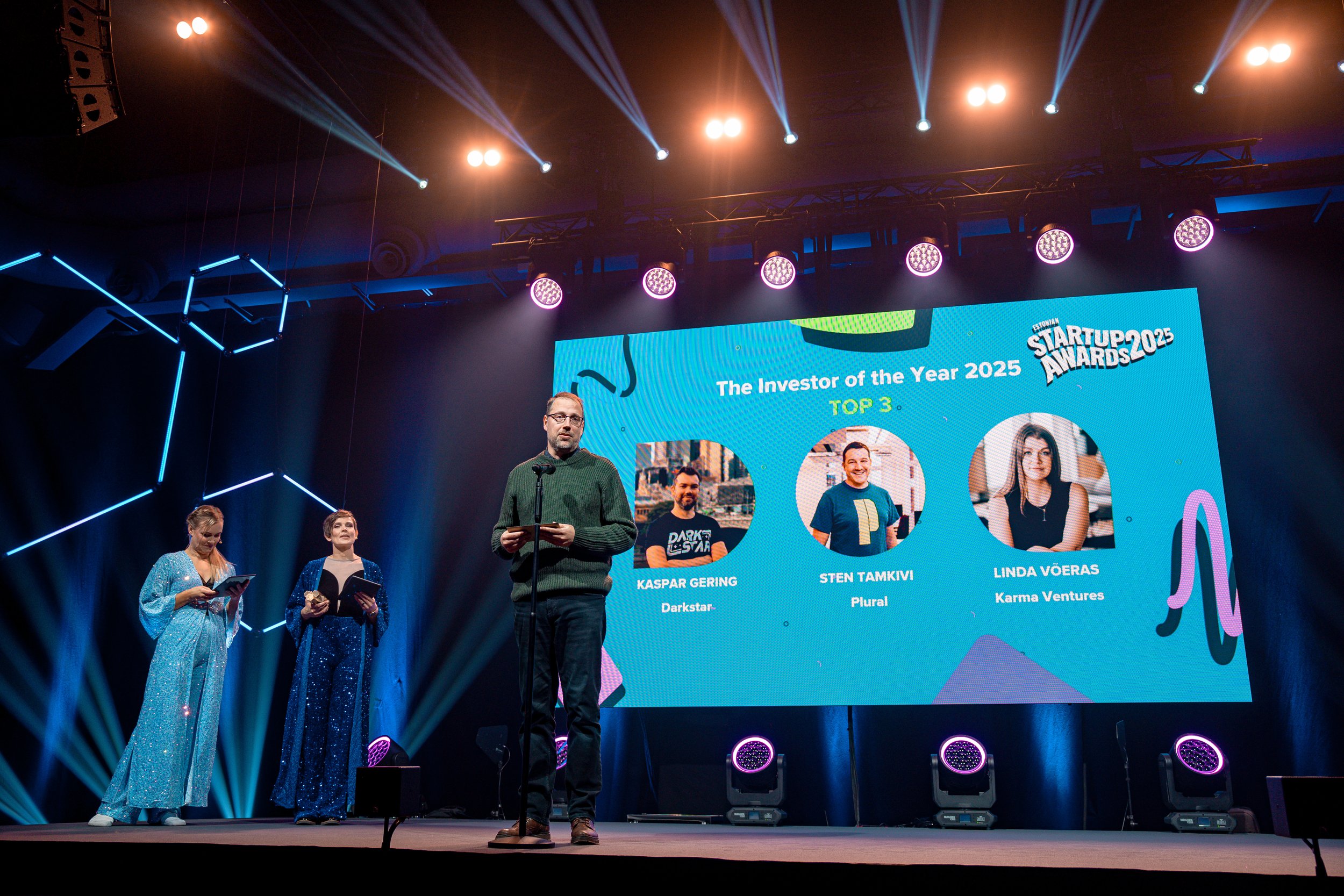
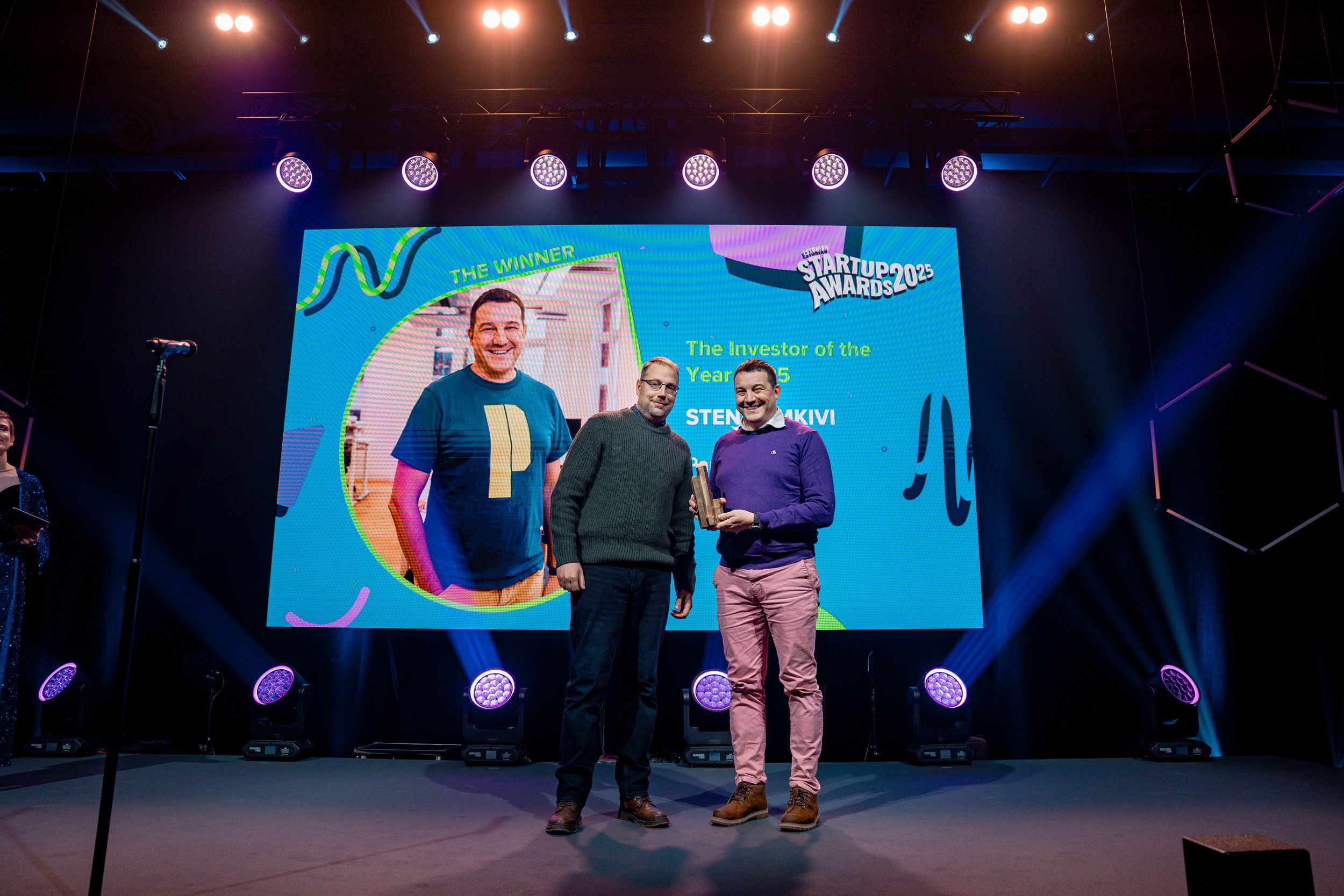
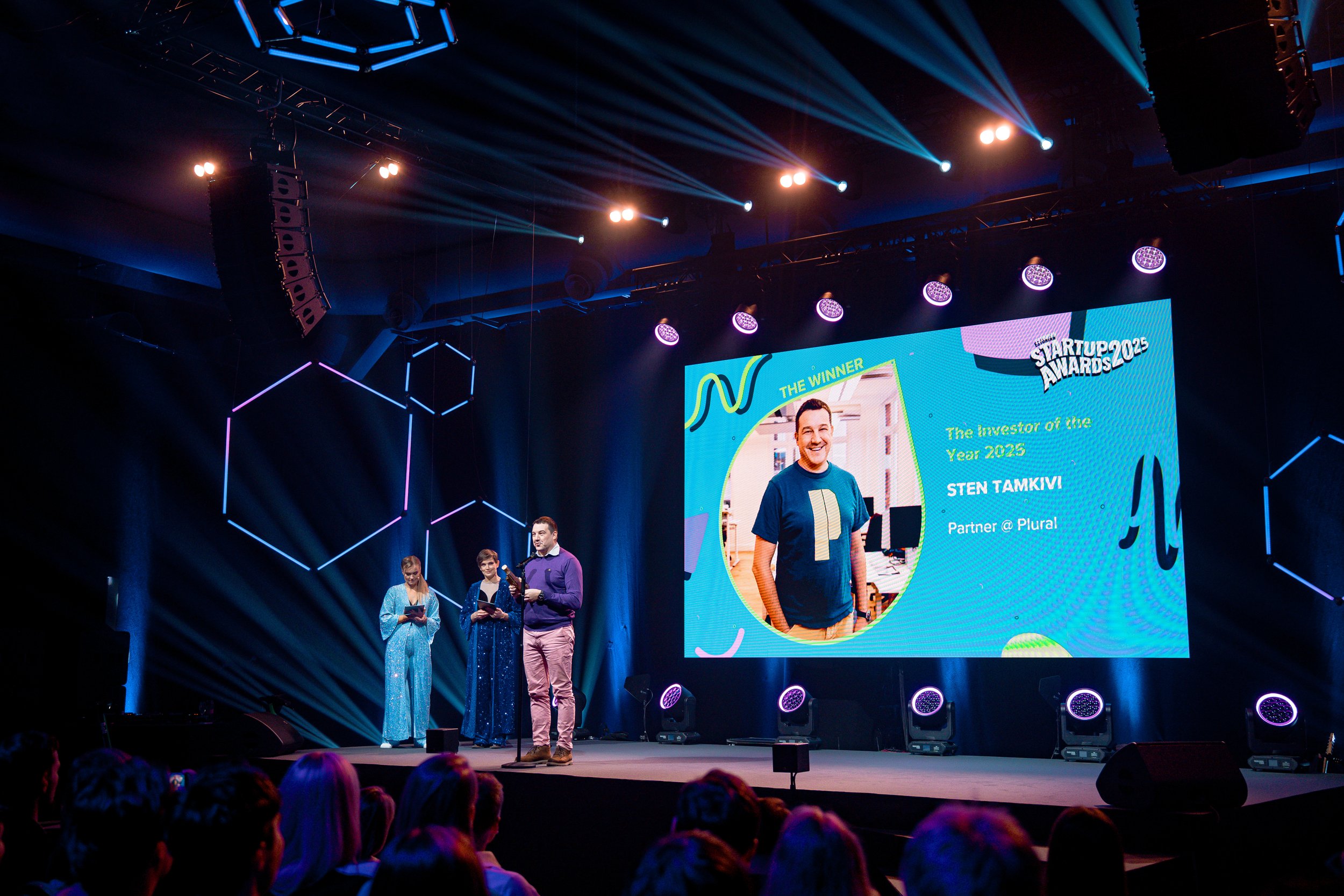
Sten Tamkivi winning the title of Investor of the Year 2025 comes with excellent timing - just shortly after Plural hit the news with planning to raise a €1B investment fund in 2026, which would make Plural one of the largest European funds. Fun fact, if we take a quick detour down the memory lane, Plural’s cofounder Taavet Hinrikus was the Investor of the Year 2024. Congrats, Plural! Great things start to happen - for the ecosystem in general - when successful founders become investors themselves!
Overall, margins were tight, in several categories, outcomes hinged on a single vote. That’s a sign of genuine competition, rising vitality and maturity of our ecosystem. As Hardware faded to the background for the moment, and Green Tech folded into the impact category this time, the center of gravity clearly shifted toward SaaS, DefenceTech, and DeepTech and AI.
If you want to watch future unicorns emerge, that’s where to look. Our bets would be on Skeleton, Pactum, Starship, Modash, Katana, Blackwall, and KrattWorks.
But onwards, dear reader, to the actual results!
The Winners and 100+ Nominees Of Estonian Startup Awards 2025
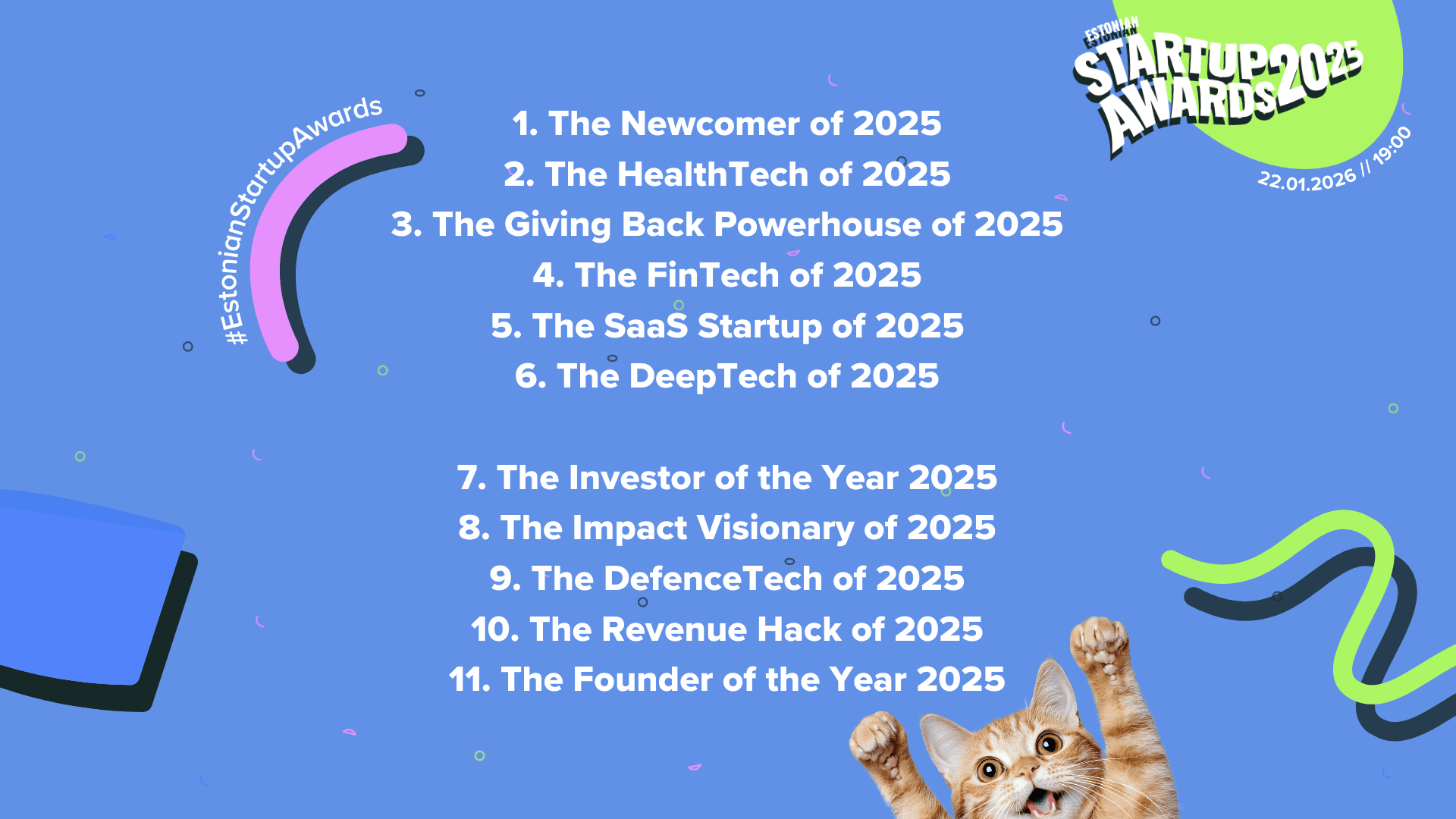
The five main categories for 2025 were Newcomer of the Year, Investor of the Year, Founder of the Year, Revenue Hack of the Year and Giving Back Powerhouse of the Year. In addition, the best performers in the fast-growing verticals of Deep Tech, Impact Tech, Defence Tech, FinTech, HealthTech and SaaS were also recognized.
* ”[…]” stands for that part of the description being marked as confidential for the public eye.
CATEGORY 1
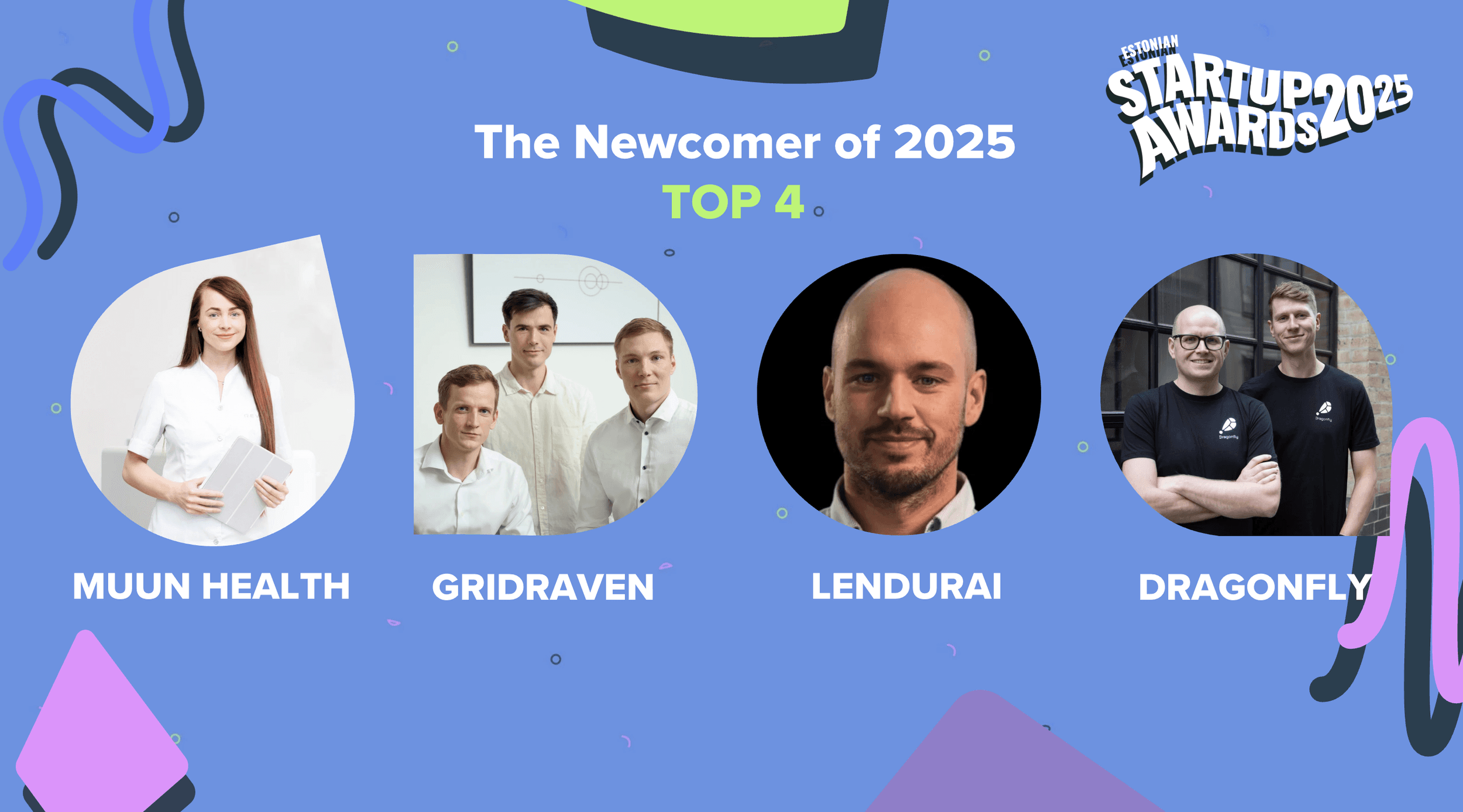
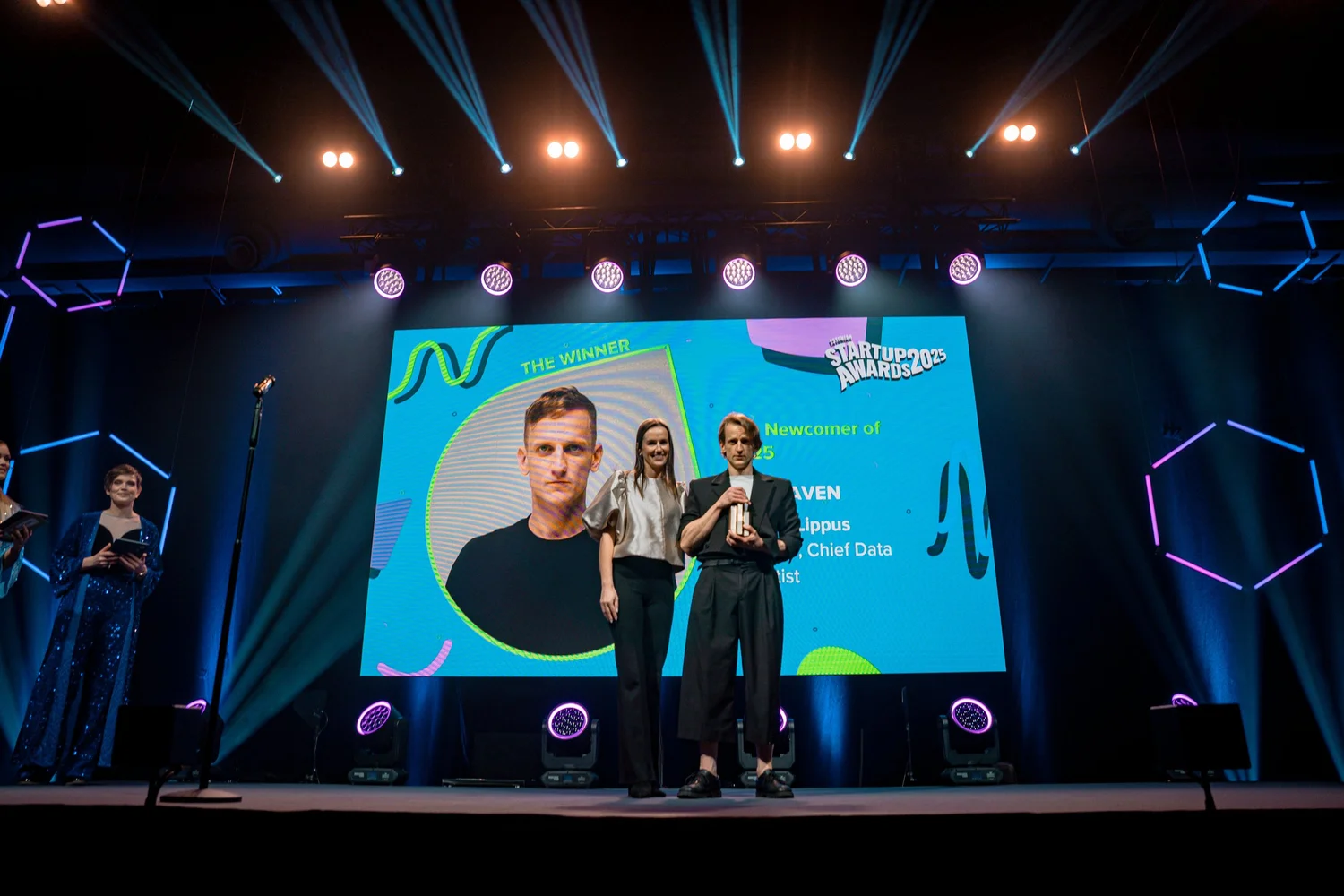
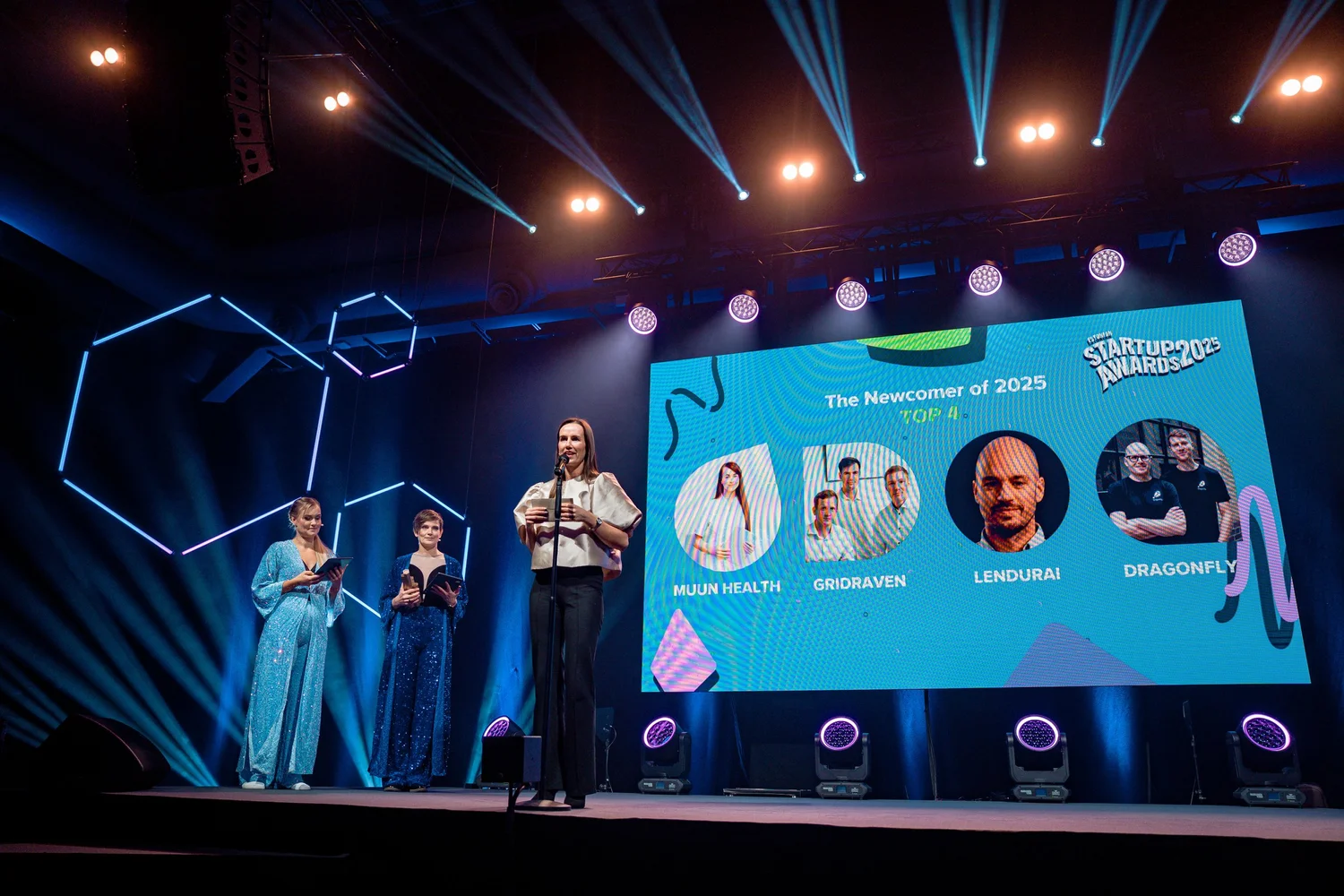
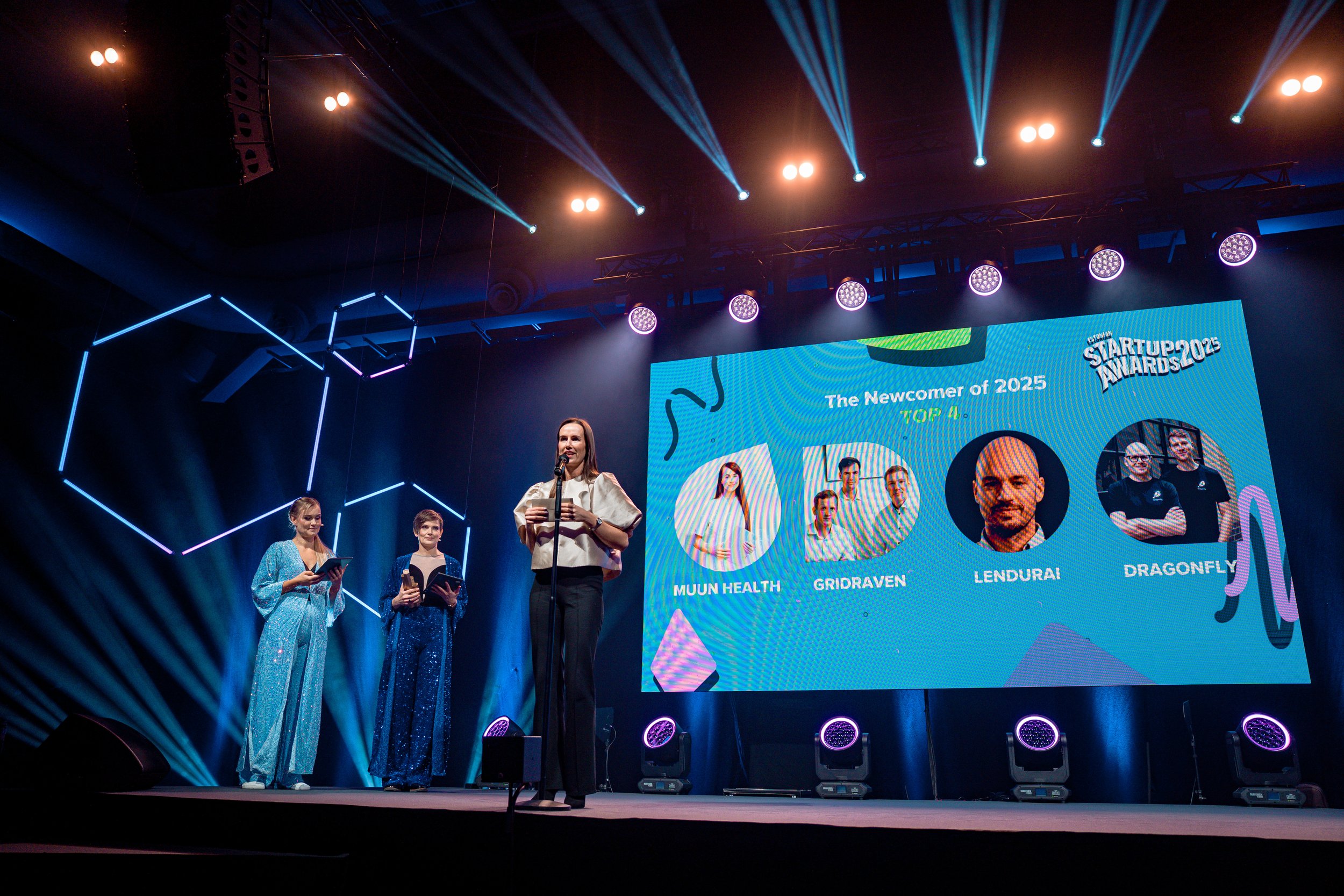
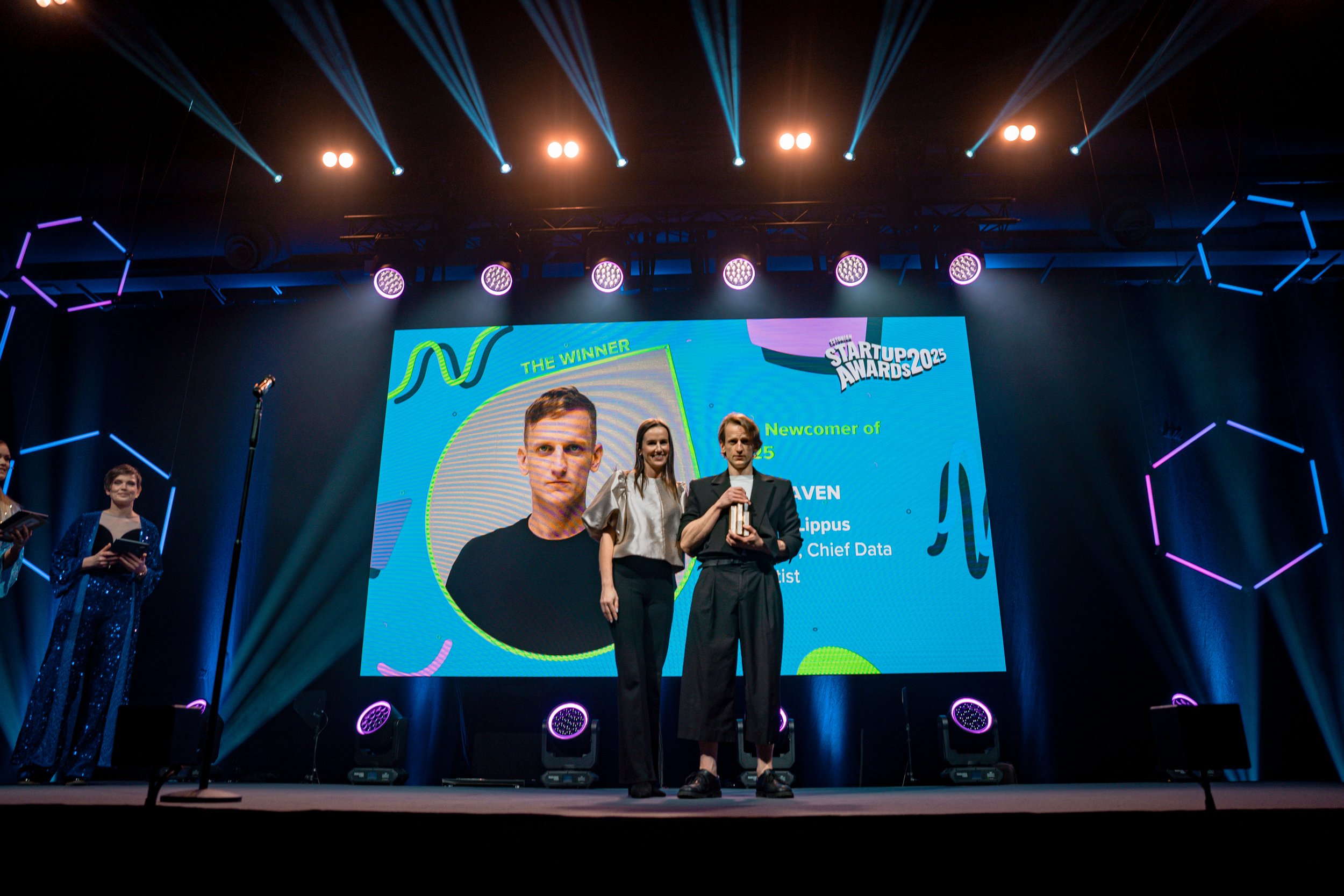
The Newcomer of 2025 - Gridraven
A truly inspiring newcomer who launched their startup within the last 3 years. They've got the passion, the business model, and all the potential to be the fastest-rising star in the next year or two... and maybe even become the future Founder of the Year?
The award was presented by Käthe-Riin Tull, the Co-Founder of TalentHub: “It’s not about the big acivements, it’s about courage. Working in recrutiment business and working close together with founders, I see their everyday struggles. 10 years ago I met Martin Villig, who asked for feedback for a taxi service… and here we are, a decade later - Bolt is now leading the startup scene.” Every great story has to begin from somewhere.
WINNER: Gridraven
II PLACE: Lendurai
III PLACE: Dragonfly
III PLACE: Muun Health
THE SHORTLIST FOR THE NEWCOMER OF 2025:
A) Creem
Creem is a Merchant-of-Record and financial operating system that helps small SaaS teams sell globally without dealing with payments, tax, or compliance complexity. In 2025, Creem launched its core MoR platform, automated tax handling, revenue-splitting infrastructure, and stablecoin payouts. Over the year, the company grew weekly GMV by over 17,000%, scaled total processed volume by eight figures, and increased ARR by more than 70x, with particularly strong acceleration in Q3 and Q4. In 2025 Creem closed a €1.8M pre-seed round and expanded from founders-only to a cross-functional core team in Estonia.
B) CryptoSwift
CryptoSwift operates at the intersection of fintech and compliance, helping crypto businesses comply with the Travel Rule - a global regulation that sheds light on who is involved in cryptocurrency transactions. The company has clients around the world, including MENA and APAC regions. Headed by Indrek Ulst (CEO & CTO) and Uve Poom (COO) - two seasoned fintech operators - and backed by Tenity, Startup Wiseguys, and DEPO Ventures, CryptoSwift is well positioned to service the rapidly evolving digital currency space. In 2025 CryptoSwift raised a €500k pre-seed round and grew its revenues 6.6x from €2400 to €16,200.
C) Dragonfly
Dragonfly is the intelligence layer between businesses and the software they need to thrive. In just 7 months, Dragonfly has assembled a world-class team from Microsoft, Zego, Google, Reddit, McKinsey, Spotify and OpenAI, and built a one-of-its-kind platform designed to help organisations adopt modern software tools.
At the core of the product is Dragonfly's Automated Solutions Architect (ASA), a technology companion that recommends a personalised technology stack to accelerate the practical adoption of AI across a business. In October 2025, Dragonfly emerged from stealth, beta-launched the first version of the platform, and announced a $3.4M pre-seed round (the largest pre-seed raise ever in the Baltic region). Since launch, the platform has supported more than 400 businesses and formed technical partnerships with industry leaders Google, AWS and NVIDIA to further accelerate product development and bring modern tools to organisations of every size.
D) Gridraven
Gridraven is the world’s leading provider of sensorless Dynamic Line Rating (DLR). Powered by ultra-precise weather prediction, our technology helps grid operators unlock up to 30% more capacity to run networks more affordably and efficiently. In 2025, Gridraven cemented its position as an industry pioneer. They raised €4M from European VCs, secured €1.5M in non-dilutive grants, and validated the solution across Elering’s full network in Estonia. Most notably, they won a nationwide tender with Finnish TSO Fingrid, making Gridraven the only DLR provider globally to successfully convert a pilot into a full-scale deployment. They have since expanded to the U.S. with a new office in Austin, Texas, and are currently advancing pilot conversations on every continent.
E) Jälle
Jälle solves the main pains of the battery recycling industry: low lithium recovery efficiency and the lack of viable solutions for graphite upcycling. USP = turning li-ion battery waste into high-value graphene-based materials. In 2025, they nailed the best proposal for EIS’s €1.0M RUP funding, €37k business development support, and won the €25k Climate-KIC award as well as the DefHack resilience hackathon. Within 4 months of forming the founding team (CEO Erki Ani joined in Feb 2025), they closed a €750k pre-seed round led by Kiilto Ventures and Norrsken Evolve, and 2C Ventures. They scaled lithium recovery to kg-scale at 80%+ efficiency, increased graphene-material production 25x. Filed their first patent and opened their lab with the Estonian President and the Minister of Climate and Energy. Started product testing with 3 customers and 3 suppliers from the EU. Team grew from 4 co-founders (phD Kerli Liivand, phD Reio Praats, Martin Jantson, Erki Ani) to 9 people.
F) Knowzilla
Founded by sales and engineering leaders from companies like Deel, Bolt, Printify and Pipedrive - Knowzilla is building a real-time sales enablement platform that helps teams ramp faster and sell more consistently. In just 3 months in 2025, Knowzilla went from concept to live product, joined the Antler Nordics program, raised €490k in funding, and onboarded its first pilot customers. Sales teams are already using Knowzilla during onboarding and live calls, validating strong demand for real-time guidance over static playbooks.
G) Lendurai
Lendurai develops advanced autonomy solutions that enable drones to operate without radio links or GNSS navigation, ensuring reliable performance in contested and denied environments. In 2025, the company reached several major milestones, most notably closing a €5.6M seed funding round to accelerate product development and expansion. Lendurai successfully expanded its presence in Ukraine and delivered its products to the Estonian and Ukrainian armed forces, demonstrating real-world product traction. The team also launched a partnership-based go-to-market strategy, helping to scale the deployment of its capabilities. These achievements marked a strong year of growth, validation, and execution.
H) Muun Health
Female-led Muun Health is developing the first wearable device (biosensor) for female hormone monitoring to tackle the global problem of infertility and to disrupt the $26B IVF market. In 2025, they grew the number of people working on the R&D from 4 to 13, reached laboratory PoC, obtained €150k in grant funding and closed the €549k pre-seed round. Established academic, industrial and clinical partnerships in 7 different countries in the EU. Their highlight was being selected for finals in multiple pitching competitions (TOP 6 in Latitude59, TOP 10 in TechChill, TOP 5 in sTARTUp Day etc).
I) ScamGuardian
ScamGuardian helps financial institutions protect their clients from scams by providing threat intelligence acquired by AI-powered conversational bots. […] The company was founded in 2025 by Silver Keskküla and Henry Rõigas, raised a €400k from early folks from Skype, Wise, Bolt, Coinbase etc., grew the team size by 300%, signed a deal with TELE2, won a grant from Estonian System Authority.
J) Sky Spy
Sky Spy provides mission-critical, AI-powered SIGINT systems for contested environments, helping allied democracies achieve spectrum dominance in the era of robotic warfare. In 2025, the company raised an oversubscribed a $xx pre-seed round, reached TRL-7, and became the first EW startup of its kind to complete […] successful combat missions on the Ukrainian frontline. Sky Spy system located […] hostile emitters with ~50m accuracy and double confirmation, including jammers and UAV control stations - enabling rapid countermeasures and saving dozens of lives. Sky Spy launched integrations with 5 OEMs globally and scaled its customer pipeline across the EU and US, establishing itself as a future leader in electronic warfare.
_____________
CATEGORY 2
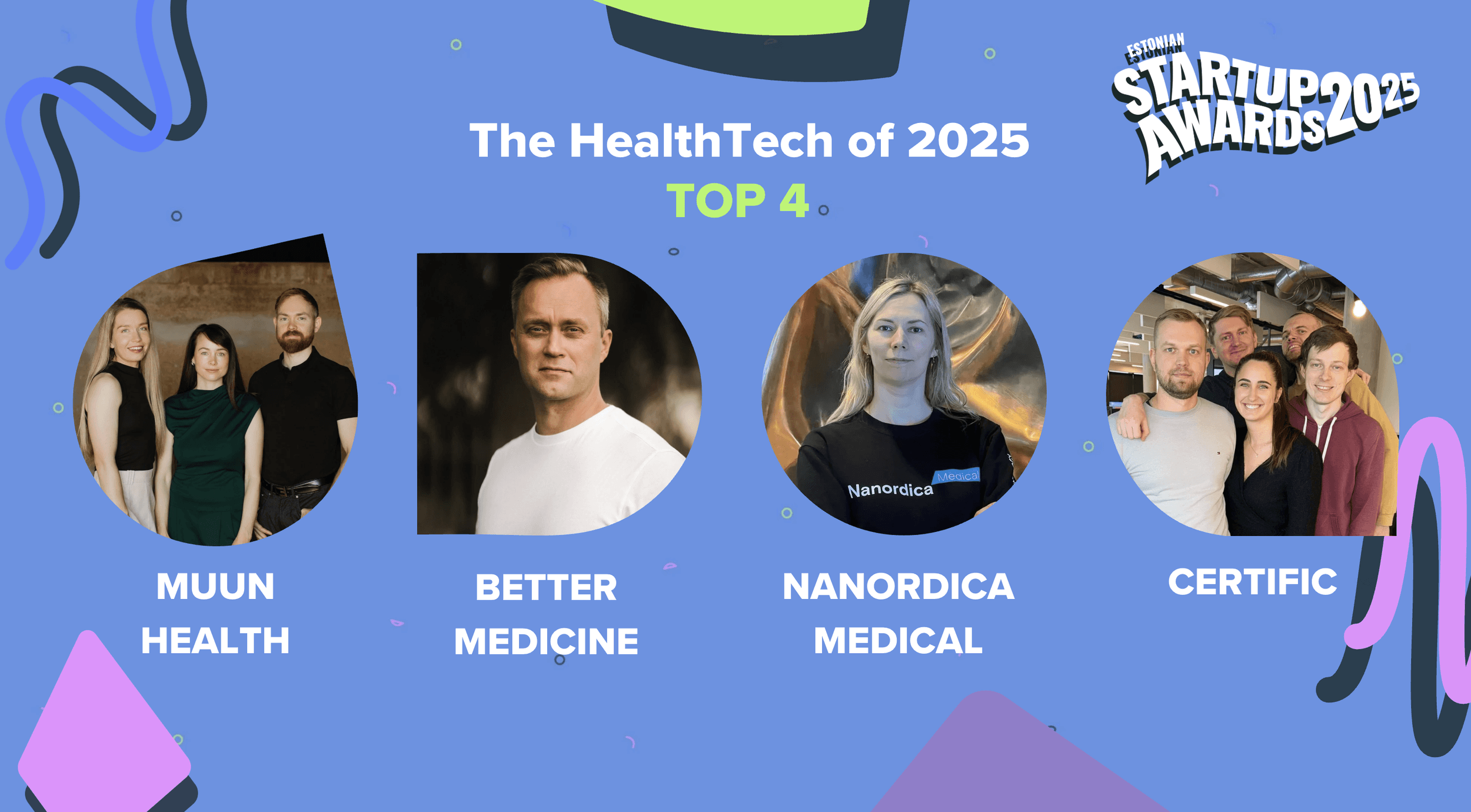
The HealthTech of 2025 - Muun Health
For years, our HealthTech vertical has been saving lives and re-imagining the future of healthcare. With a unique digital platform and collaborative ecosystem, Estonia is well-positioned to soon take the lead on a global scale with solutions in preventative medicine, patient self-treatment, industry efficiency, etc. Who has pushed the boundaries in 2025?
The award was presented by Tiit Keldo, the CEO SkipEat: “Today is the anniversary of Apollo 5 launch, it was about testing the systems that would keep people alive in space. Back in the day, science had more reason to suspect failure than success. […] If science works, it has a great impact for all of us.” These startups are deep into science, saving lives and improving the well-being for all of us.
WINNER: Muun Health
II PLACE: Better Medicine
III PLACE: Certific
III PLACE: Nanordica Medical
THE SHORTLIST FOR THE Healthtech of 2025:
A) Antegenes
Antegenes’ genetic tests assess individual cancer risk using polygenic risk scores and provide clinical recommendations for personalised cancer prevention. Their approach has the potential to reduce mortality from the most common cancers by up to 30–40%. Estonia is the first country in the world to offer polygenic risk score–based breast cancer screening for younger women free of charge through the national health system, using Antegenes' AnteBC test. They published 2 peer-reviewed scientific articles, including the world’s first international clinical guidance on breast cancer polygenic risk scores. Their personalised breast cancer prevention service was recognised as one of Europe’s most outstanding health technology innovations, receiving second place at the EIT Awards 2025. They also launched a next-generation personalised prostate cancer prevention service with Tartu University Hospital. Antegenes achieved 100% increase in net sales and are operational in 7 countries.
Better Medicine develops the world’s first clinically validated AI solution for cancer detection. The solution aims to assist radiologists in identifying cancer earlier and faster.
C) Certific
Certific (known as Perearst24.ee in Estonia) is changing how doctors communicate with patients. In 2025, Certific became the market leader in Estonia, reaching 49% market share. More than half of the country’s population has access to the platform, and 1,613 doctors and nurses rely on it every day. The year's defining milestone: over 1 million health concerns submitted, establishing Certific as core clinical infrastructure nationwide. Certific is also helping set a legal precedent and standard for Europe, as secure communication platforms become mandatory nationwide in Estonia from 2026. Building on this momentum, Certific completed ISO 27001 certification in a matter of months, deployed AI-supported clinical workflows and expanded into Hungary to support further European scaling.
D) Gelatex
Gelatex is pioneering industrial-scale patented nanofiber technology for medical devices, wound care, cosmetics and alternative proteins. In 2025, they signed their first licensing agreement (royalty-based) with a global med‑tech leader and grew revenue 140% compared to 2024. They delivered prototypes for implants, wound‑care scaffolds and dissolving patches, grew the number of granted patents from 4 to 7, filed 3 new patent applications, expanded distribution to the U.S., and secured multiple major partners. This breakout year validated our tech-transfer model, strengthened our IP, and positioned them for major growth in 2026.
E) Lifeyear
Lifeyear is building the operating system for digital cardiology - an AI-enabled remote patient management platform that allows health systems to deliver high-quality specialist cardiac care beyond the hospital, reducing avoidable admissions, freeing clinical capacity, and improving patient outcomes. In 2025, Lifeyear closed a €2.8M pre-seed round, including a €1.5M grant from the Enterprise Estonia Applied Research Programme, welcomed Oxford University Hospitals as a shareholder, and strengthened its leadership with Dr. Eleanor Wicks, an NHS-trained cardiologist with over 20 years of clinical experience, joining as Co-Founder and Chief Medical Officer. The company was selected Top 10 out of 250 startups for the UK Founders Factory Hospital to Community Accelerator, supported by a £100k Innovate UK grant, and is seeing growing interest from hospitals and integrated care systems across the UK, laying the foundation for early clinical deployments and commercial partnerships in 2026.
F) Muun Health
Female-led Muun Health is developing the first wearable device (biosensor) for female hormone monitoring to tackle the global problem of infertility and to disrupt the 26B $ IVF market. In 2025, they grew the number of people working on the R&D from 4 to 13, reached laboratory PoC, obtained €150k in grant funding and closed their €549k pre-seed round. Established academic, industrial and clinical partnerships in 7 different countries in the EU. Their highlight was being selected for finals in multiple pitching competitions (TOP 6 in Latitude59, TOP 10 in TechChill, TOP 5 in sTARTUp Day etc).
Nanordica Medical develops first-in-class wound care products for healing of chronic wounds. In 2025, Nanordica Medical secured ISO 13485:2016 certification and built an R&D lab in NICPB, their own startup garage. The company was granted its first patent, and its technology was further validated by two R&D grants exceeding €200,000 and acceptance of its first peer-reviewed clinical publication. They identified a rare reimbursement-protected market opportunity in Germany. Commercial traction followed with 10+ NDAs/LOIs signed and over 150 qualified leads generated at EWMA, the world’s largest wound care conference. The year closed with submission of technical documentation for conformity assessment to support CE marking of Nanordica’s first human product and regulatory submission to FDA, marking the final steps before launch.
H) Shen.AI
Shen.AI turns smartphone cameras into clinical‑grade monitors: a face scan captures 30 vital signs and health markers, including blood pressure. With 1 line of code, health apps, providers and payers embed the SDK to monitor patients remotely - faster and at scale, without wearables. In 2025 we shipped a multimodal AI that uniquely combines rPPG with rBCG achieving clinical validation and medical certification leading in accuracy, reliability and inclusivity - resulting in exceptional 4x ARR growth to €1.25M. Shen is used by 72 customers from 32 countries, led by the U.S. and Europe.
_____________
CATEGORY 3
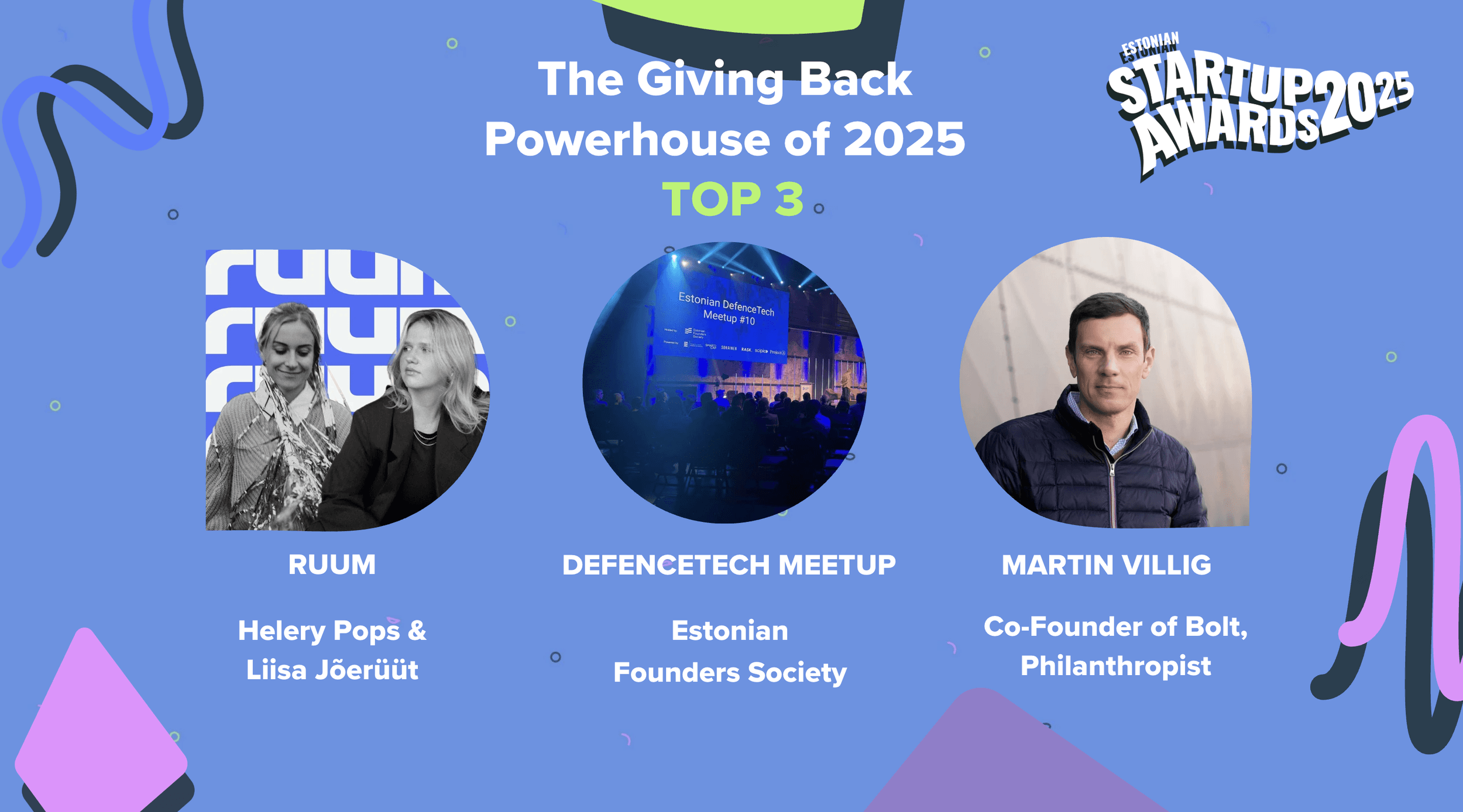
The Giving Back Powerhouse of 2025 - DefenceTech Meetup
Our ecosystem needs activists (and friends) to grow. Those who dream differently, and also take action. Whether an organization, event, initiative, or individual - their passion and contribution has strengthened the Estonian startup ecosystem in 2025. Whose impact has left the strongest mark in your heart and mind?
The award was presented by Astrid Maldre, the Small Business and Start-up Segment Manager at Swedbank: “Every great business speaks of a moment of inspiration - an idea that just wouldn’t quit going “what if?”. Our startup scene rocks because all of you. There is a saying that the meaning of life is to take the next step: we can nail small things solo, but for big things we need a boost. Tonight, we celebrate a powerhouse who has taken a number of big steps and made a real impact.”
WINNER: DefenceTech Meetup
II PLACE: ruum, Helery Pops & Liisa Jõerüüt
III PLACE: Martin Villig
THE SHORTLIST FOR THE giving back powerhouse of 2025:
A) AI Leap 2025
AI Leap (TI-Hüpe) is Estonia’s pioneering nation-wide initiative integrating AI into education through a public-private partnership between President Alar Karis, the Ministry of Education and Research, industry partners (including Skaala Impact, Smart Future Foundation, Telia), and OpenAI and Google. Launched in 2025, the programme secured partnerships with frontier LLM developers and successfully reached 154 (99%) of high schools by September 1st and 4646 (99%) of high school teachers by October. With trainings and school-based professional learning communities, the initiative achieved 2000 daily active users within first months and empowered 10% of teachers in creating their own custom Gem or GPT.
B) Creative Destruction Lab Estonia
Creative Destruction Lab is a global mentorship program for deep tech startups. In 2025, they continued building their impact portfolio, with supporting entrepreneurship in Estonia as a clear priority. It’s been great to see Creative Destruction Lab kick off its third cohort locally, giving Estonian founders access to world-class mentors and truly global networks. This spring, they’ll also run the Norrsken Evolve program in Tallinn, strengthening Nordic collaboration in a very tangible way. The momentum of student-led initiatives like Wave Ventures, Nucleate, Junior Achievement or Hüppelaud is equally energizing. But maybe most rewarding is to see how Helery Pops has built ruum in Krulli—the first hugely successful step in creating a vibrant home for future builders on their way to Kasvuhoone.
The Estonian DefenceTech Meetup has firmly established itself as a flagship event not only for the Estonian but also for the regional defense tech industry. Arranged every two months, it draws 300-500 participants and features speakers from the industry, military, and investor circles, along with dozens of presenting startups. In two years, this event has become a must-attend for anyone who is building defence startups. Estonian DefenceTech Meetups have helped galvanize support for establishing the Estonian Defence Fund and the Estonian Defence Forces Innovation Command.
Health Founders Estonia (HFE) supports and empowers the Estonian health tech ecosystem by building shared pathways, knowledge, and access. In 2025, HFE delivered its first accelerator cohort of 34 startups through the DEFINE, DEVELOP and GROW programs, helping founders move from idea to market. HFE (co-)organised multiple founder- and community-focused events, helped lead the shaping of the national healthtech innovation roadmap, and contributed to cross-sector cooperation through a Memorandum of Understanding. To reduce one of the sector’s biggest barriers, HFE introduced a founder-to-founder regulatory approach, enabling peer learning and real-world knowledge sharing. Internationally, HFE hosted foreign delegations and journalists, as well as shared our knowledge and expertise abroad. Together with President Alar Karis, visits were made to the United Kingdom, alongside several important conferences and meetings in Paris, Malta, Amsterdam, Finland, and elsewhere, while growing its LinkedIn community to nearly 2,000 followers.
E) Helery Pops & Liisa Jõerüüt - ruum
In 2025, ruum launched as a hacker space in krulli for early-stage builders. While it’s never been easier to build tech alone, doing it in parallel with others on a similar journey turns out to help. A lot. ruum brought 11 teams into one space. No rent, no equity, no capital letters, and no pressure to look good for investors. "We worked. We shipped. We talked about what broke in weekly retros. We opened the doors for demo nights and the occasional techno party," say Helery and Liisa. ruum has been a community effort from day one. Shaped by founders, powered by partners, and supported by people who showed up simply to help build (sometimes by writing code, other times by moving furniture). Liisa Jõerüüt and Helery Pops have spent almost a decade in startups and investing. ruum is one of the ways they’re putting that experience back into the ecosystem, with more to come.
Over the past four years, Martin has dedicated 80% of his time to contributing to societal and ecosystem-level initiatives in Estonia. In 2025, he focused strongly on advancing a culture of giving back, including public speaking and advocacy—most notably at the Swedbank Private Banking Forum, reaching over 600 of Estonia’s most influential private individuals. Since summer 2025, Martin has coordinated a policy initiative to modernise Estonia’s foundation law, enabling family foundation and trust-like structures to keep capital, philanthropy, and long-term impact anchored in Estonia. In parallel, he continues his long-term work with Heateo Foundation and the Education Fund, supporting education and leadership development. His personal commitment is to donate 50% of his annual income and donate 90% of all his assets to philanthropy.
G) Rode Luhaäär
Rode Luhaäär's focus is on strengthening the regional startup ecosystem in Viljandi through hands-on community building, founder education, and direct startup support. A key milestone was launching StarHub Viljandi, a local startup hub created to bring founders together outside the main startup centres. Around StarHub, he helped organise multiple initiatives, including startup introduction seminars, the Restart program, Startup Safari workshops, the IDEKAS pitch contest, local tech nights, and the upcoming Fellin Häkk hackathon. These events provided practical entry points for new founders and helped grow a visible local tech community. In 2025, Rode consulted 8 startups, several of which are now progressing well, and mentored founders through programmes such as the EWA food program. His contributions extend to education and advocacy: presenting startup funding principles to local investor communities, running annual startup-focused sessions within his internet marketing lectures at Mainor University, and experimenting with new formats such as a local startup podcast.
H) Skaala
In 2025, Skaala continued building their impact portfolio, with supporting entrepreneurship in Estonia as a clear priority: "It’s been great to see Creative Destruction Lab kick off its third cohort locally, giving Estonian founders access to world-class mentors and truly global networks. The momentum of student-led initiatives like Wave Ventures, Nucleate, Junior Achievement or Hüppelaud is equally energising. But maybe most rewarding is to see how Helery Pops and Liisa Jõerüüt have built ruum in Krulli—the first hugely successful step in creating a vibrant home for future builders on their way to Kasvuhoone." This spring, Skaala will also run the Norrsken Evolve program in Tallinn, strengthening Nordic collaboration in a very tangible way.
I) Techstars Startup Weekend Tallinn
Techstars Startup Weekend Tallinn's team successfully organized 2 hackathon events at EBS throughout 2025 with the aim to inspire the next generation of entrepreneurs in Estonia. These events opened the door to the startup world for 110+ students from universities like TalTech, EBS, TLU, and others. Participants came together to test their ideas, connect with each other, and improve their skills along the way. Besides building their solutions, students made valuable connections in major Estonian startup organizations like Latitude59, Tenity, Tera VC, EstBAN, and others; noteworthily, 4 teams continued working on their solutions after these hackathons, and multiple participants remained active in the Estonian startup ecosystem.
_____________
CATEGORY 4
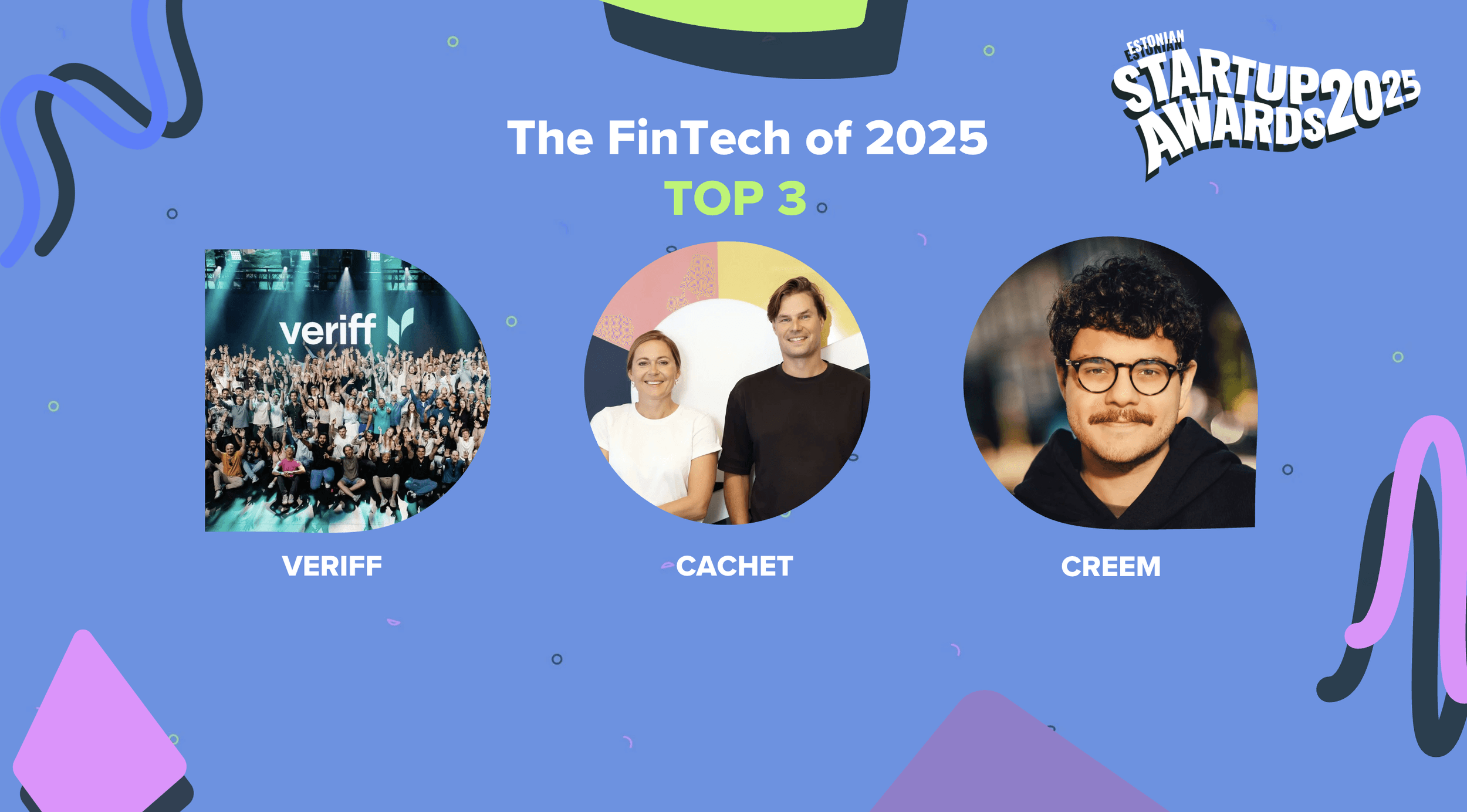
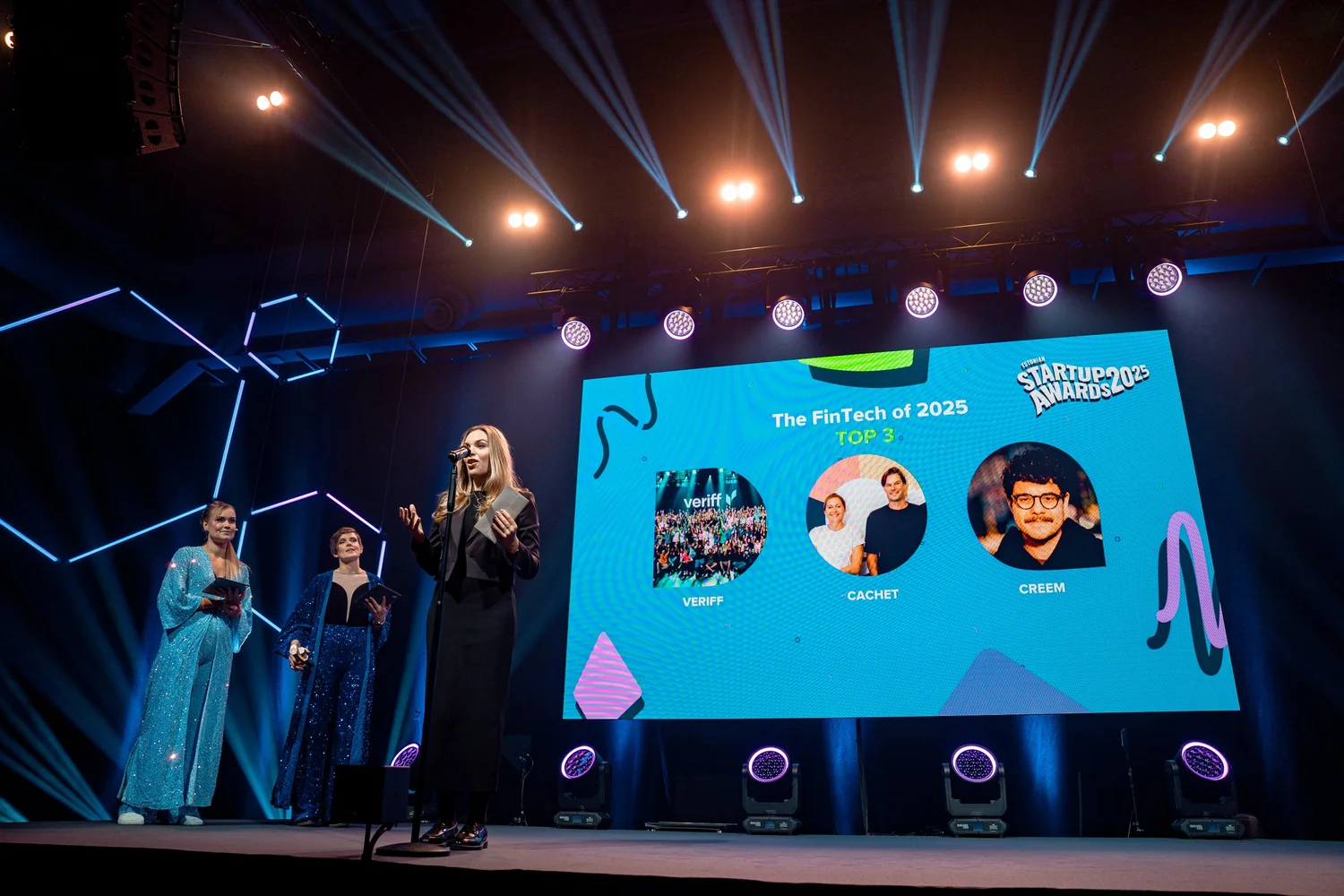
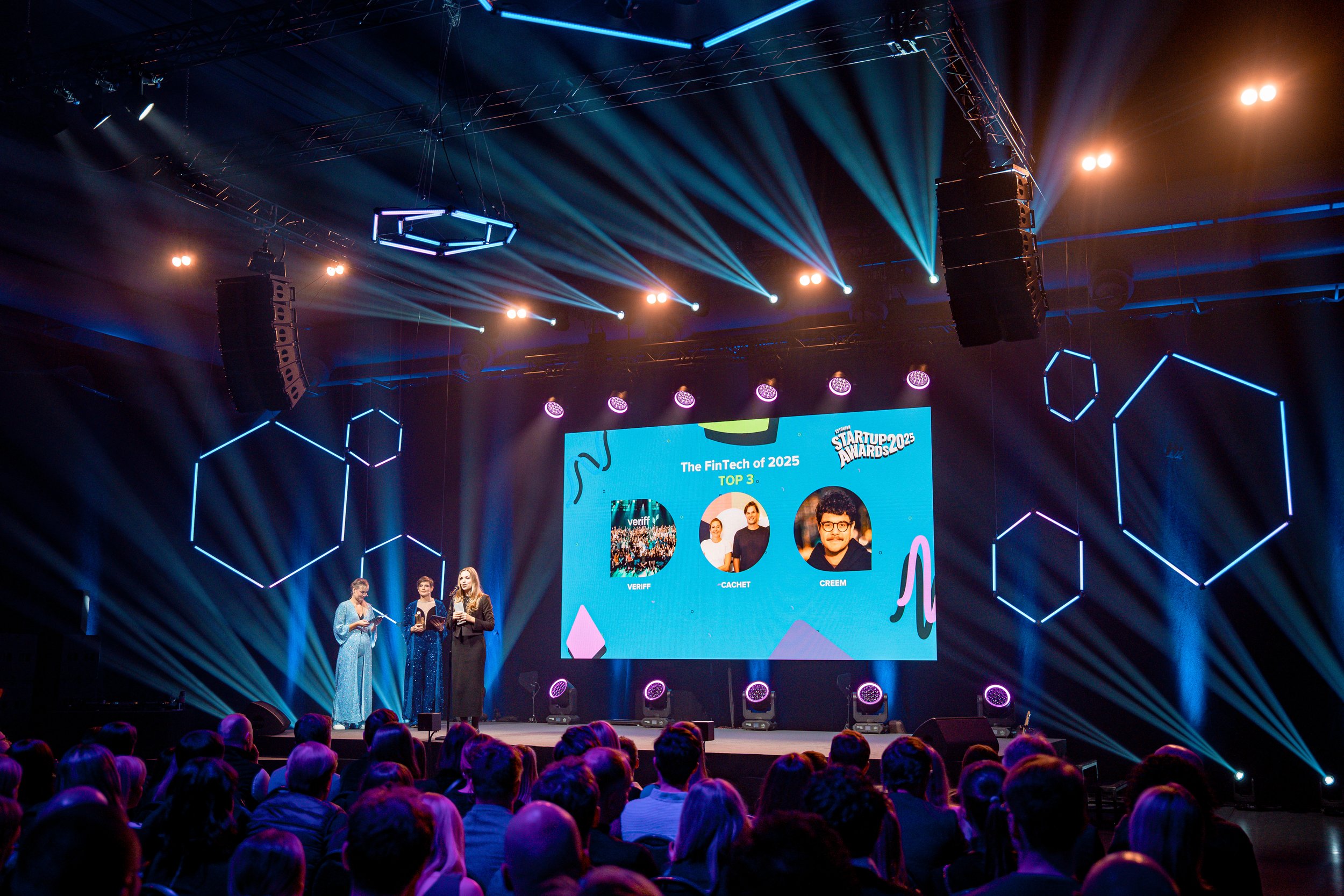
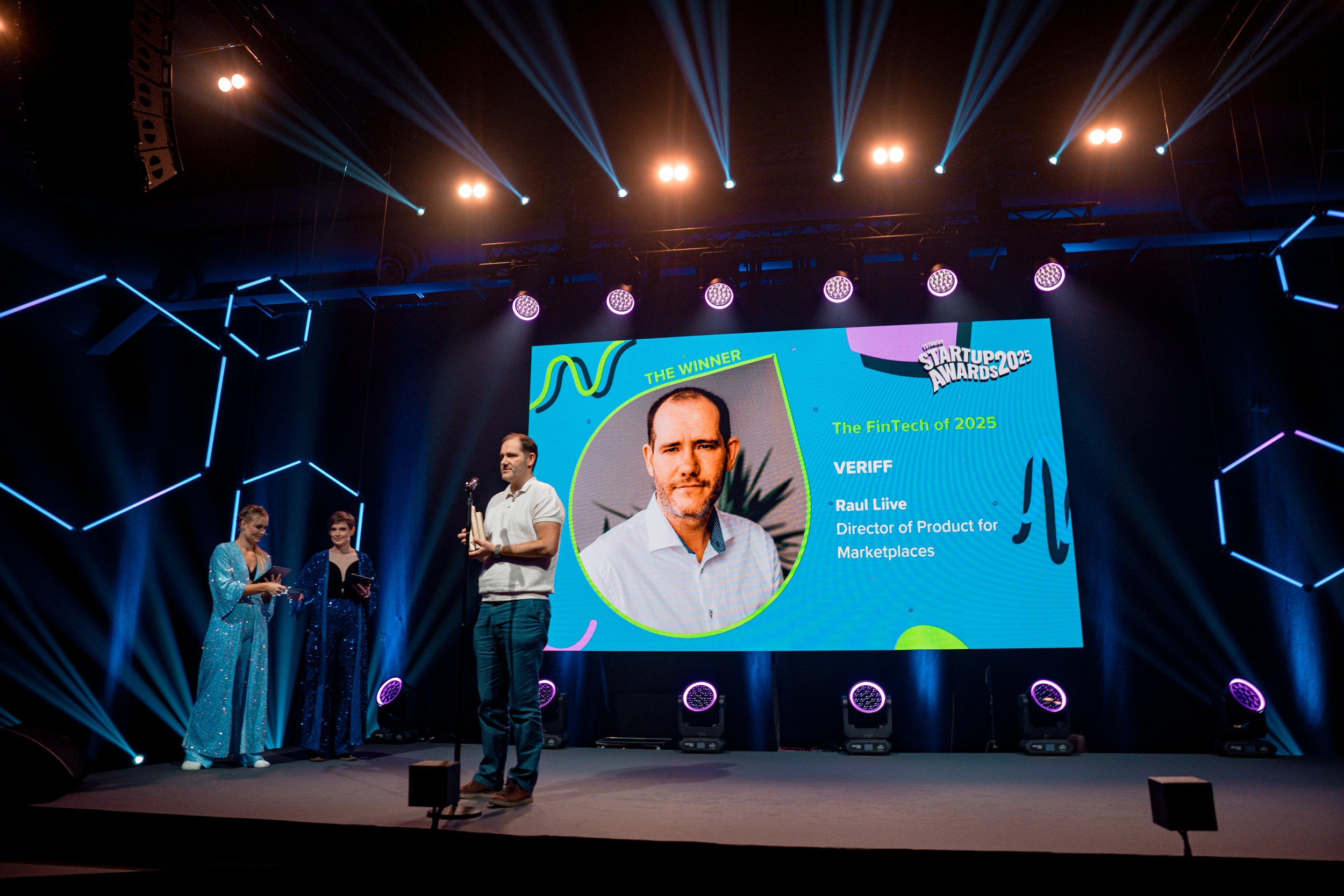
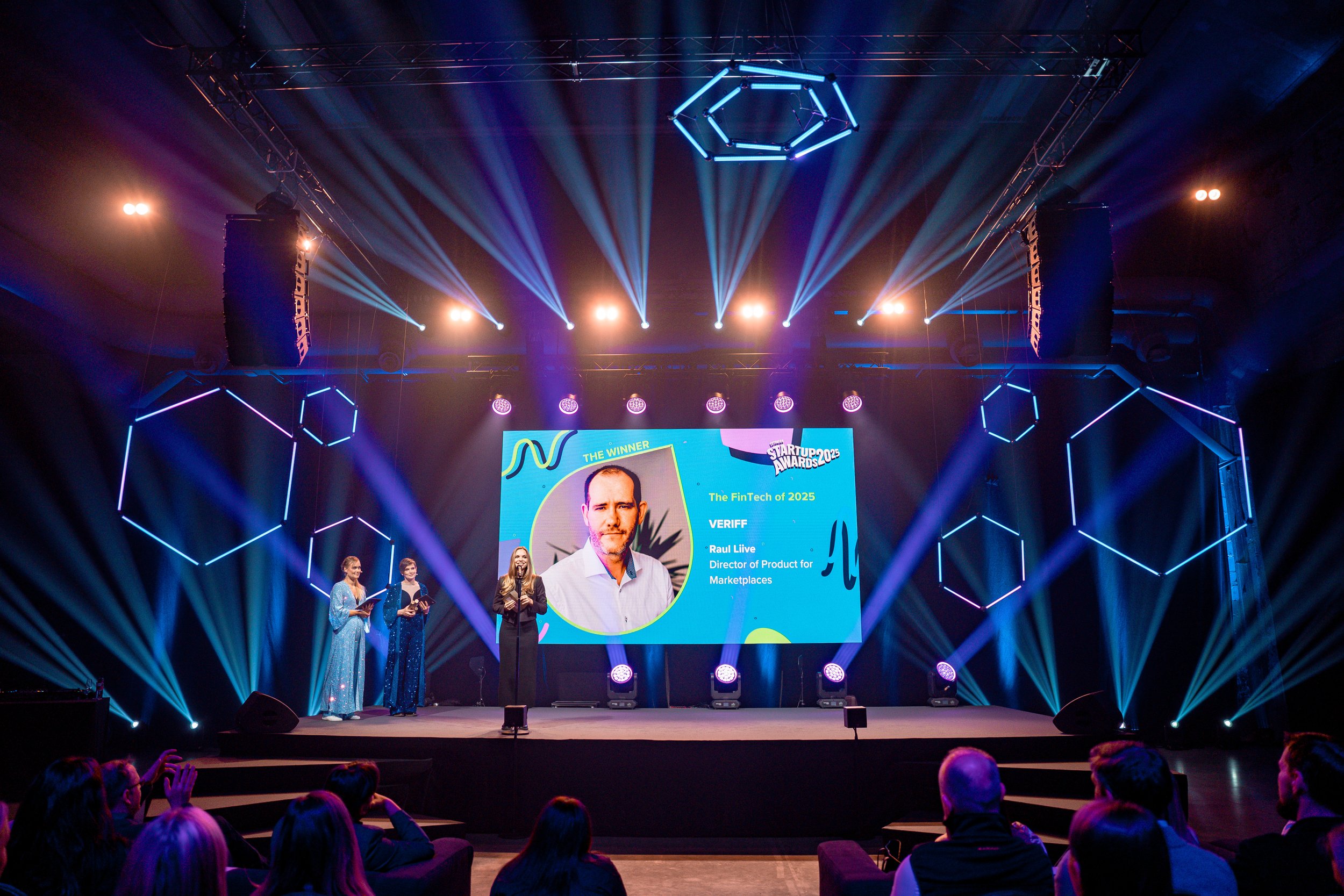
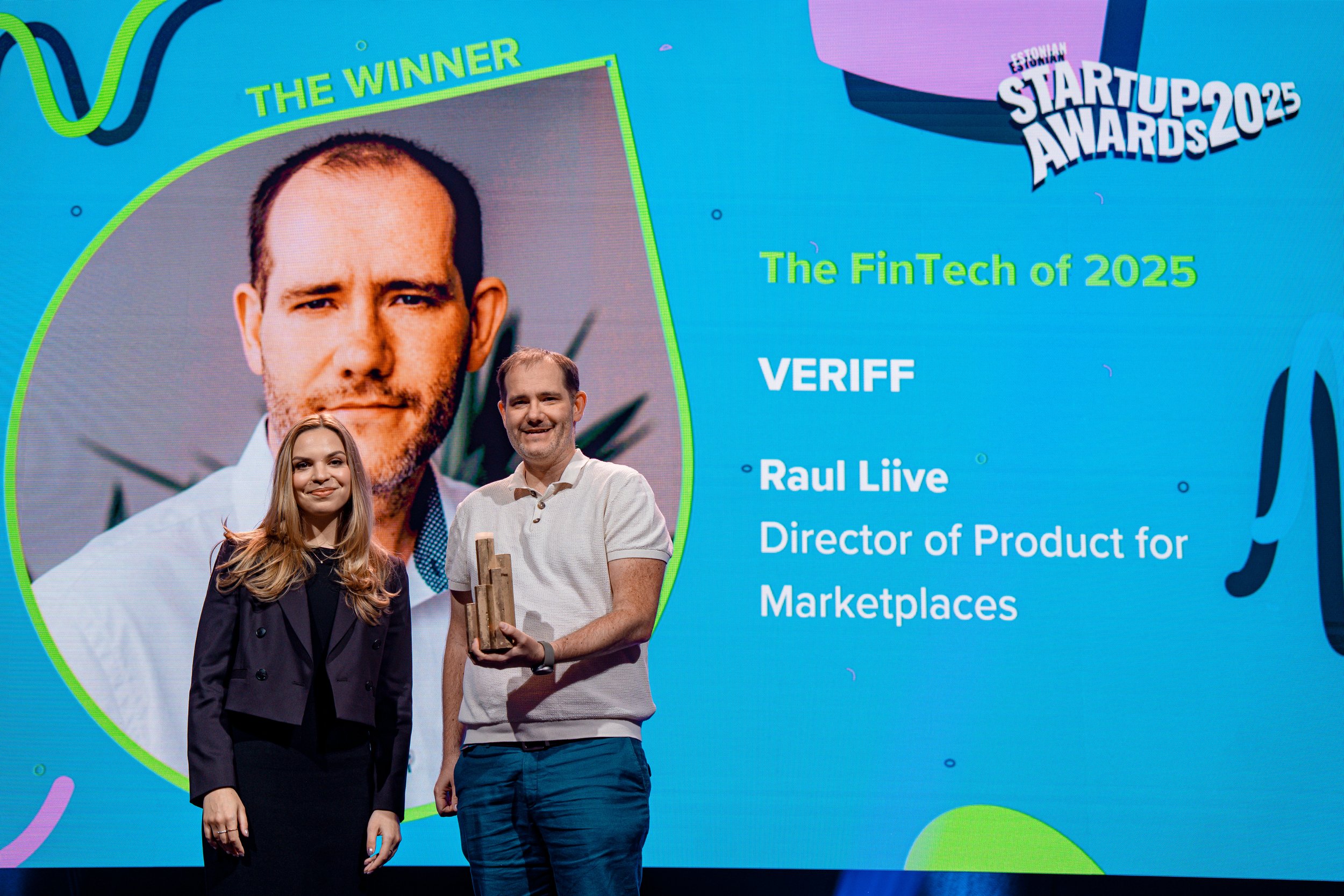
The FinTech of 2025 - Veriff
Estonia’s FinTechs keep rewriting the rules of money-management. From smarter payments to bolder financial tools, these startups are shaping the future of how we earn, spend, grow, access, or re-allocate - proving that clever ideas can move more than just money. Who has played it the smartest in 2025?
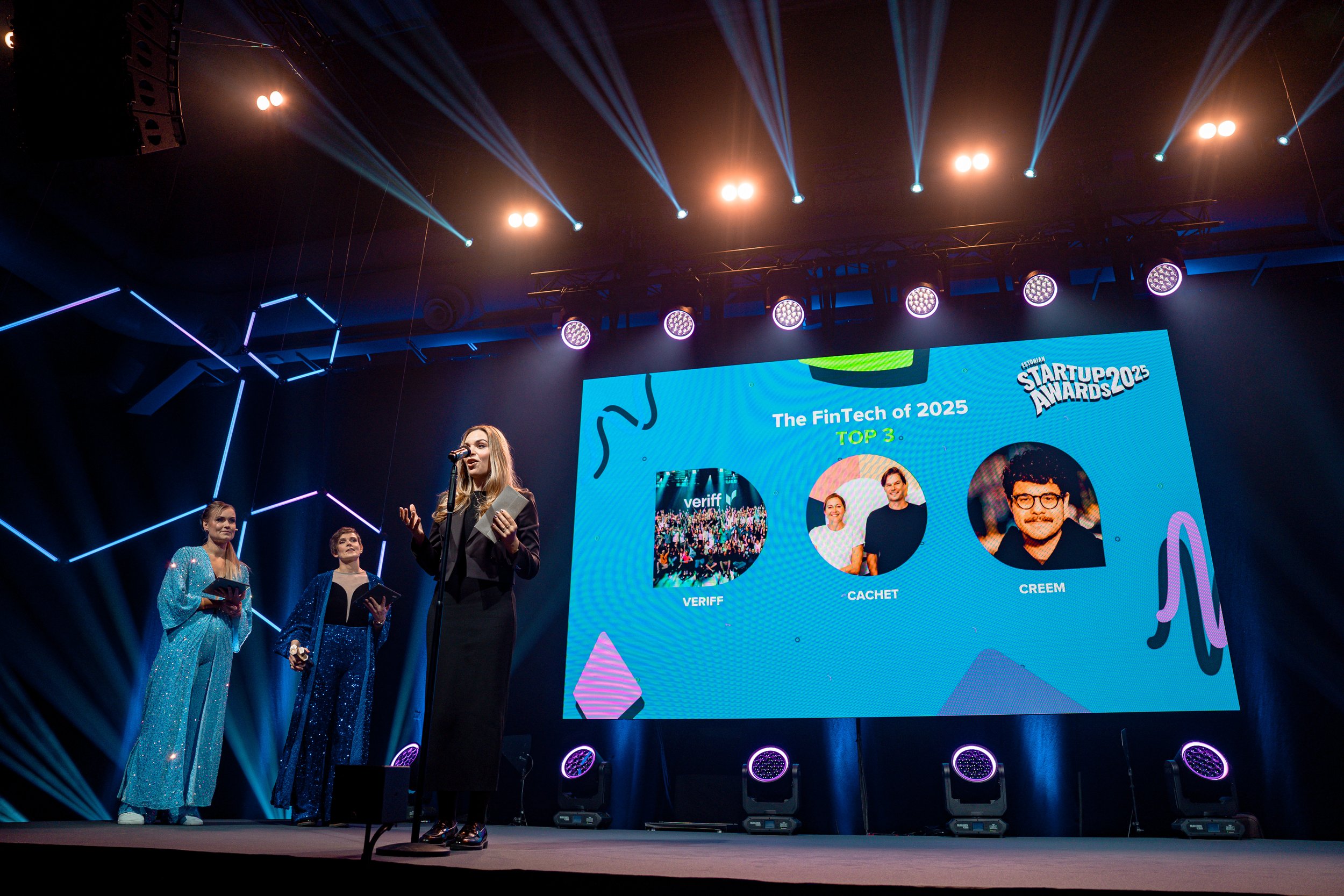
The award was presented by Monika Stanislovaityte, from the Northern & Eastern European Sales team at PayPal.
THE SHORTLIST FOR THE Fintech of 2025:
A) Cachet
Cachet is building the insurance infrastructure for Europe's platform economy. In 2025, they broke new ground: expanding to 16 markets and becoming the leading provider of shared mobility coverage across the Nordics and Baltics, with rapid growth in the Benelux and Germany. Revenue grew 2.5x year-on-year, whilst posting a EBITDA-positive year. The company expanded its client base to an all-time-high, including partners like Bolt and TaskRabbit, and now manages 250,000+ assets on its platform. Cachet’s adaptive insurance solutions made 550 million minutes of rides possible, as insurance shifted from compliance headache to competitive advantage for their partners.
B) Creem
Creem is a Merchant-of-Record and financial operating system that helps small SaaS teams sell globally without dealing with payments, tax, or compliance complexity. In 2025, Creem launched its core MoR platform, automated tax handling, revenue-splitting infrastructure, and stablecoin payouts. Over the year, the company grew weekly GMV by over 17,000%, scaled total processed volume by eight figures, and increased ARR by more than 70x, with particularly strong acceleration in Q3 and Q4. In 2025 Creem closed a €1.8M pre-seed round and expanded from founders-only to a cross-functional core team in Estonia.
C) Finfra
Founded by Markus Prommik and Reinis Simanovskis, Finfra is an embedded lending infrastructure platform enabling specialised lenders to scale SME credit in Indonesia. The company addresses an estimated ~$75B SME financing gap locally and a >$300B gap across Southeast Asia. In 2025, Finfra's highlight was launching the lending partnerships with Tyme Group to deploy Merchant Cash Advance products via leading POS and ride-hailing platforms. During the year, Finfra more than doubled its AUM, increased gross profit by ~60%, diversified revenue streams across multiple clients, and entered 2026 with a signed pipeline—including Paytm, Tilt, and Asialink—supporting up to 5× AUM growth and 1.5–2× gross profit growth.
D) Mifundo
In 2025, Mifundo scaled its pan-European credit data infrastructure from pilots to supporting real cross-border lending decisions. Over 45 million Europeans live or work outside their home country, but their credit histories stop at borders. This blocks access to financial services and leaves banks without risk data for a €700 billion market. This year, Mifundo partnered with credit bureaus in nearly 20 countries, covering 70% of Europe's population, including global corporations like Experian, Equifax, CRIF, and Schufa. Major European banks signed as clients, with more than a dozen banks onboarding. MRR increased 5x.
E) Monemon
Monemon is a consumer fintech on a mission to close the growing pension gap and help young adults become financially independent on their own terms. […] In 2025, they consistently ranked among the top finance apps across major platforms, onboarded 7,000+ customers, and surpassed €500,000 in card transaction volume with steady month-over-month growth. They launched everyday banking services, payment cards, MoneWorld and their first proactive AI features. During the year, they expanded their team to 15 people and moved into a new office in Telliskivi, laying the foundation for accelerated growth across Europe in 2026.
F) Montonio
Montonio is a leading provider of ecommerce checkout solutions, supporting over 8,000 online stores across the Baltics and Poland. This year, the company processed over €1.5B in payment volume and grew monthly recurring revenue by more than 60%. Montonio launched its services on Shopify, completed the rollout of its full product suite across the Baltics, expanded shipping services to Poland, and introduced an official Partner Program, now working with over 100 agency partners. Looking ahead, Montonio aims to accelerate growth by expanding its product offering and scaling into new European markets.
G) Salv
Salv is a European RegTech company helping banks and fintechs prevent financial crime through real-time collaboration and advanced AML technology. In 2025, Salv became profitable while scaling efficiently with a team of fewer than 30 people. The platform was used over 1 billion times on an annualised basis to run financial crime checks and investigative processes across fraud, AML, and sanctions. Annual recurring revenue reached €3.7m, driven by strong growth among banks and payment institutions across 15+ countries. Salv continued expanding its pan-European footprint, enabling faster fraud prevention and recovery while staying aligned with upcoming EU AML and payment regulations.
H) Tuum
Tuum is a modern core banking platform that enables financial institutions to innovate freely and serve customers with confidence. In 2025, Tuum acquired 9 new customers across 7 new countries, growing ARR by over 70% and expanding into the MENA region with the launch of a dedicated Islamic Banking product suite. The platform was globally recognised as Best Challenger Core Banking System by the FinTech Futures Banking Tech Awards and named a Leader and Emerging Innovator in the SPARK Matrix™ by QKS Group.
I) Veriff
A global identity company Veriff doubled revenue past the $100M scale, reached profitability, tripled service volumes year-over-year, and continued winning major global customers, including Bumble, Instacart, Uber, and Western Union.
After taking a decade to verify 400 million people, Veriff is now on track to complete another 400 million verifications by May 2026, driven by the global businesses’ need to catch AI-generated fraud. In March, Veriff opened a tech hub in Brazil and continued to expand across Latin America, the Middle East, Africa, and APAC, deepening its footprint in emerging markets.
J) Wallester
Wallester's two powerful and complementary solutions - Wallester Business and Wallester White-Label - tackle the pressing financial challenges modern companies face, from managing complex corporate expenses to launching full-scale embedded finance ecosystems under their own brand. As a Visa Principal Member, Wallester delivers direct access to global payment infrastructure, removing traditional barriers and enabling faster, more secure and more flexible financial operations across 37 countries. 2025 marked phenomenal growth for Wallester, with transaction volumes exceeding €2B. The company's annualized revenue reached €27.8 million (YoY Growth +62%). Wallester had issued over 7 million cards and was serving 6500 active clients. The company also opened two new offices, the first its new headquarters in Tallinn’s Golden Gate, while the second saw the French operations relocate to Cannes. Both moves support the company’s rapid growth and ambition.
_____________
CATEGORY 5
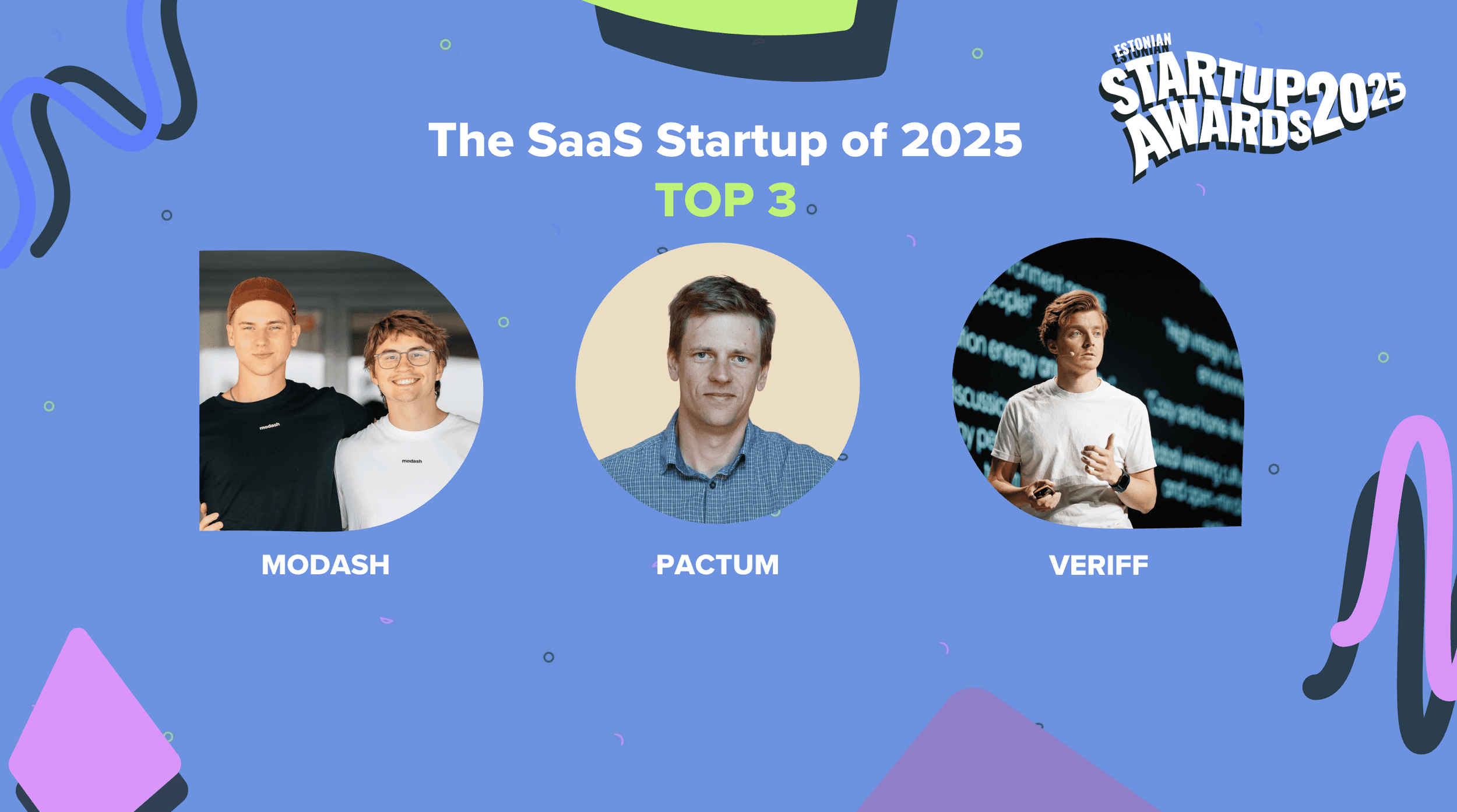
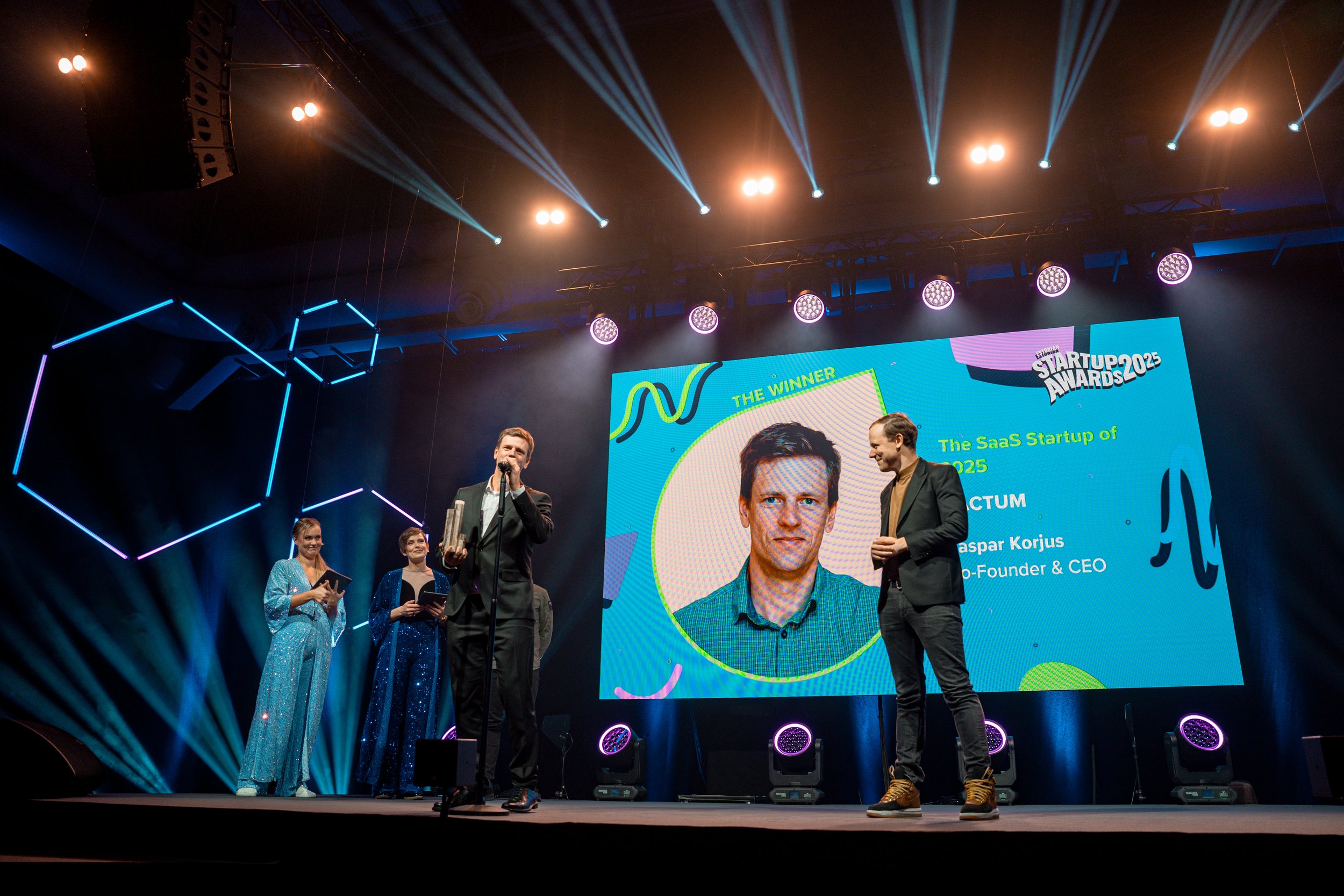
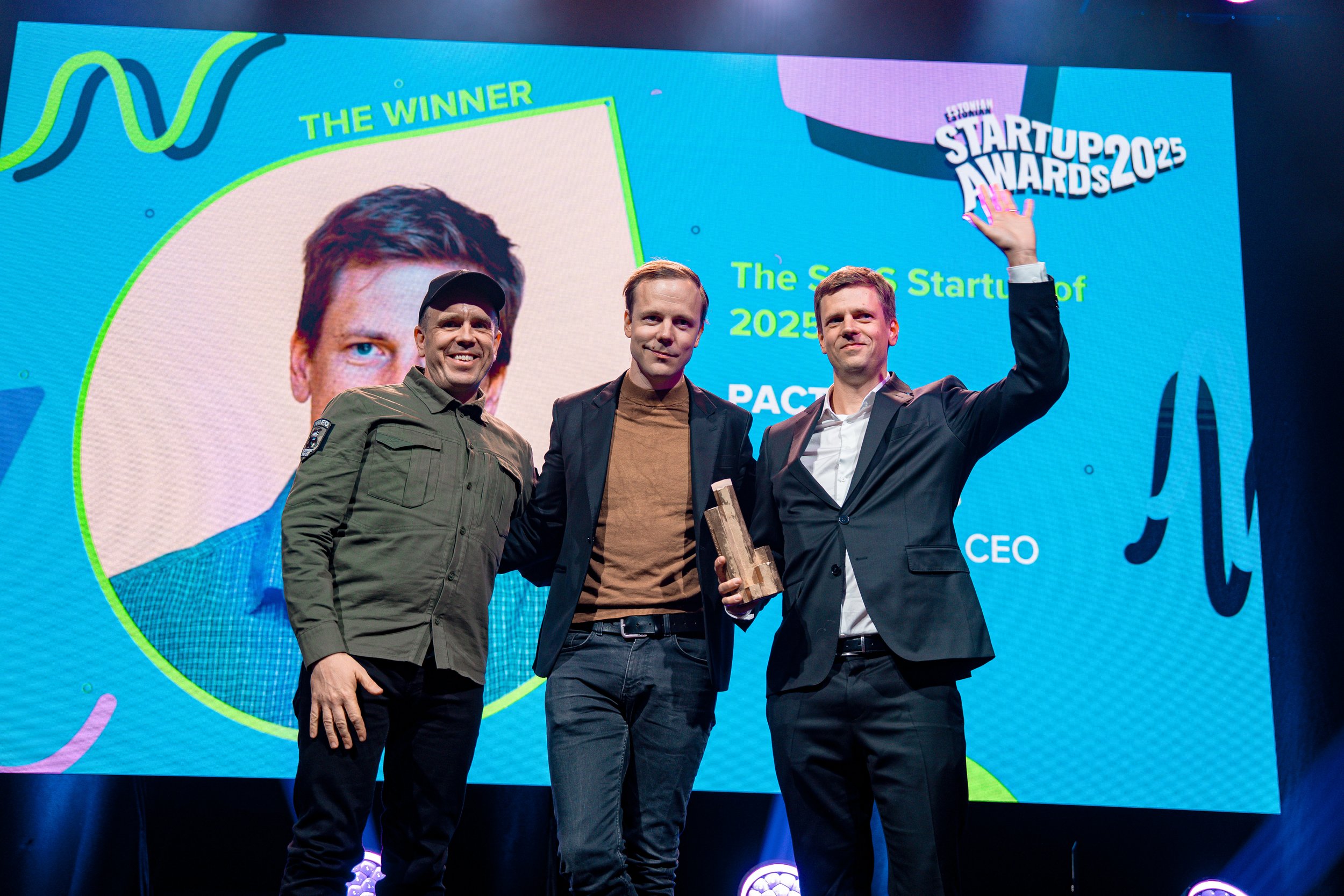
The SaaS Startup of 2025 - Pactum
It's no secret that Estonians have always had a soft spot for SaaS models - they promise a lucrative recurring revenue, potentially high margins, plus they’re attractive for acquisitions and investors alike. But it also makes the SaaS market highly competitive! Who has managed to stand out in 2025?
The award was presented by Ragnar Sass, the Co-Founder of Pipedrive: “I think SaaS is the most boring part of the awards... but after 10 years in Pipedrive, I’ve discovers this crazy fact - it’s boring to build but it’s crazy good if you do it right. I look around and I see that the most exciting things are failing, and the most boring things are bringing great results. So this is SaaS - still rocking the startup scene after 10 years, with some of the companies delivering €10 million in ARR.”
THE SHORTLIST FOR THE Saas of 2025:
A) Bisly
Bisly develops scalable, AI-driven building automation to reduce energy use and CO₂ emissions across Europe. 2025 marked Bisly’s transition from a startup into a fast-growing international company under CEO Ants Vill’s leadership. The company closed a €4.3M Series A1 round, nearly doubled revenue year-over-year, and doubled its headcount, while expanding to 40+ partners across the Baltics, Nordics, Poland, DACH, and the UK. Bisly won the Mastercard Lighthouse Impact Potential Award, secured multiple R&D grants, and scaled its platform multifold, turning intelligent, low-carbon buildings into a deployable reality.
B) Blackwall
Blackwall (formerly known as BotGuard), provides a cybersecurity platform designed to protect web resources from automated threats such as malicious bots, DDoS attacks, and fraud. It works by filtering traffic at the entry point, before it reaches a client's server infrastructure, to identify and block unwanted activity in real time. The company has raised €45M. In 2025, Blackwall's revenue grew from €8.2M to €12.3M.
C) Katana
Katana is reimagining ERP for SMBs selling physical products - including manufacturers, retailers, and distributors. Built on the belief that the future of ERP is not a monolithic business suite, Katana positions itself against incumbents like SAP, NetSuite, and Microsoft Dynamics with a composable, best-of-breed approach. Its platform serves as the system of record for over 1,500 paying SMBs globally, helping them manage purchasing, manufacturing, orders, and inventory to deliver the right product to the right customer at the right time—while avoiding stockouts and overproduction. Katana operates in the global cloud ERP market, with a total addressable market of $220B. The start of 2025 was challenging, as tariff uncertainty in North America led many SMBs to postpone ERP investments. In response, Katana recalibrated its product organization and transitioned fully to a prompt-first engineering approach to build faster with fewer headcount. In autumn, the company closed a €14M Series B extension at an increased valuation, securing a multi-year runway. Growth accelerated in the second half of the year, with ARR surpassing $13M by year-end, representing 25% year-over-year growth, and Q4 sales order volumes nearly doubling compared to 2024.
D) Modash
Modash helps brands like Burga, Sunday Riley, and Stanley1913 partner with content creators, helping those brands grow and helping creators earn a living doing what they love. 2025 was a crazy year for Modash: they acquired Promoty, assembled their Canada team from scratch, and built a unique AI search product that helps brands find high-quality creators who are often overlooked. This drove faster growth, crossing 2,000 customers and the $10M ARR mark, all while staying efficient with a net burn of just $1M.
E) Pactum
Pactum AI builds autonomous negotiation agents that negotiate deals at scale for the world’s largest enterprises. In 2025, they doubled the customer base, adding BMW, Rolls-Royce, AstraZeneca, Nestlé and UPS amongst others; raised Estonia’s largest round - $54M led by Insight Partners; grew the team from 99 to 155; surpassed the magical $10M ARR; while the agents negotiated 4x more $$$ than in the first five years combined.
F) Salesforge
As a former VP Sales, Frank Sondors has built Salesforge to blend sales teams with AI agents in a single software to deliver more sales pipeline and reduce the cost of acquisition by reducing sales headcount. In 2025, they launched a mobile app, a Chrome extension and 3 new products - LinkedIn engagement, Leadsforge and Primeforge - helping their customers now deliver up to 30% reply rates and seven-figure pipelines. They opened a new office, scaled to 40+ team, 4M SEO pages and with double-digit growth have been named the top 10 European AI agent company by Sifted together with Lovable & n8n.
G) Sera AI
Sera builds AI agents that find potential B2B customers and book sales meetings for your company. In 2025, Sera launched its AI agents, grew to […] ARR, raised a €1.5M seed round led by Maki.vc, and grew the team from 3 people to 8 people.
H) Shen.AI
Shen.AI turns smartphone cameras into clinical‑grade monitors: a face scan captures 30 vital signs and health markers, including blood pressure. With 1 line of code, health apps, providers and payers embed the SDK to monitor patients remotely - faster and at scale, without wearables. In 2025, they shipped a multimodal AI that uniquely combines rPPG with rBCG achieving clinical validation and medical certification leading in accuracy, reliability and inclusivity - resulting in exceptional 4x ARR growth to €1.25M. Shen is used by 72 customers from 32 countries, led by the U.S. and Europe.
I) Soldera
Soldera is an AI-native metalayer unifying Europe’s fragmented energy certificate registries, reducing admin costs by 95% and cutting out middlemen. In 2025, they executed a breakout year: revenue exploded from €150k to €1M with consistent 557% YoY growth as they expanded to 15 regions. They now serve 4,000+ power plants with a combined output exceeding Enefit’s total annual production. Backed by Lifeline Ventures, Skaala, Lemonade Stand, and a €1.6M EIS grant, and trusted by 500 companies - including Fortune 500s and a global top-20 asset management firm. They are unifying the grid to capture a $13B market on track to hit $80B by 2030.
J) Veriff
The global identity company Veriff doubled their revenue (passing the $100M scale), reached profitability, tripled service volumes year-over-year, and continued winning major global customers, including Bumble, Instacart, Uber, and Western Union. After taking a decade to verify 400 million people, Veriff is now on track to complete another 400 million verifications by May 2026, driven by the global businesses’ need to catch AI-generated fraud. In March, Veriff opened a tech hub in Brazil and continued to expand across Latin America, the Middle East, Africa, and APAC, deepening its footprint in emerging markets.
_____________
CATEGORY 6
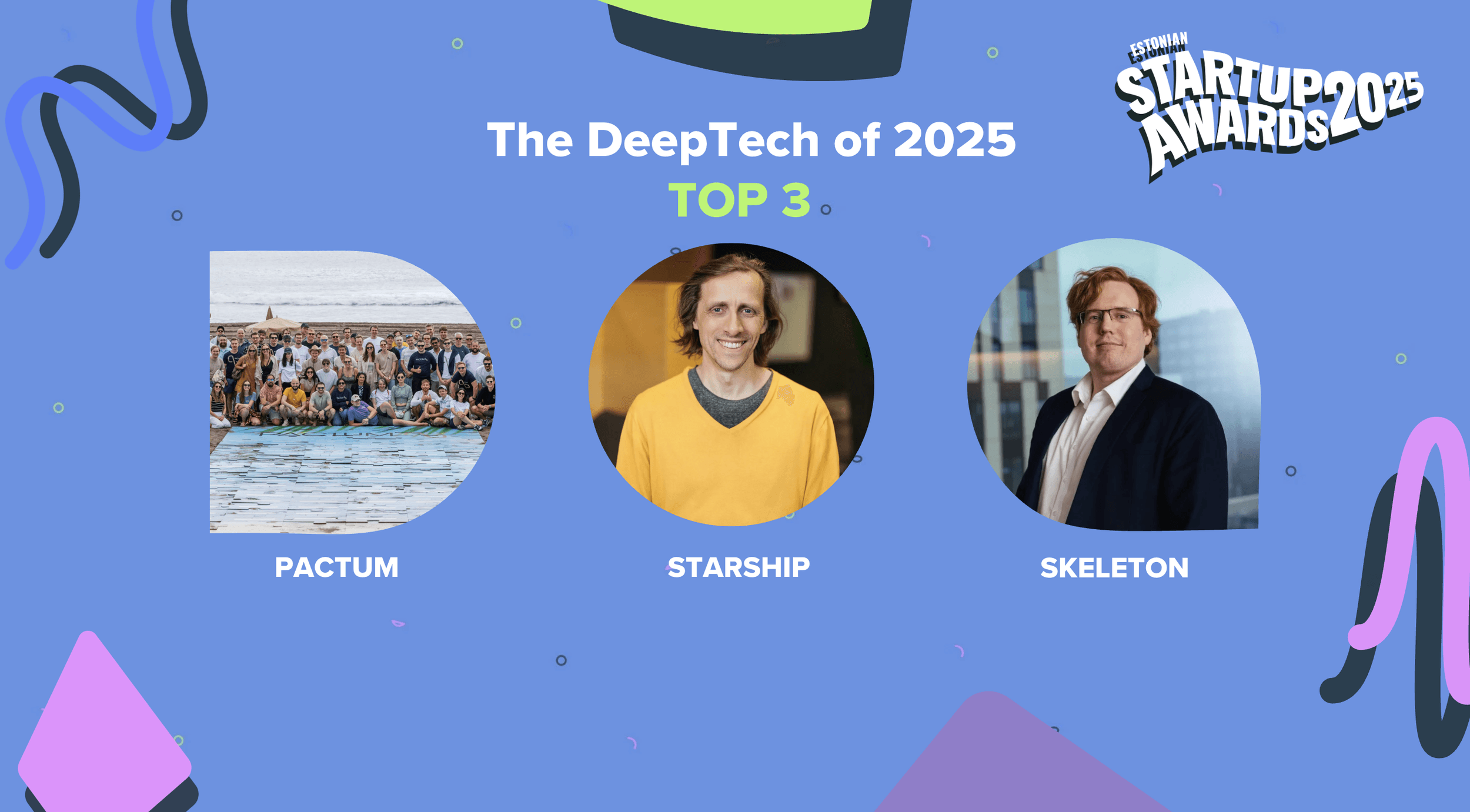
The DeepTech of 2025 - Skeleton
By the end of Q2 2025, DeepTech companies had generated €189.9M in turnover (up 11% from 2024), contributed €32.6M in labor taxes, (up 12% from 2024), and employed 2,514 people (about 15% of all sector employees). The breakthrough technologies of this vertical - in AI, biotech, advanced manufacturing, and more - are driving real impact.
The award was presented by Sigrid Rajalo, the Deputy Secretary General for Economics and Innovation at the Ministry of Economy and Industry of the Republic of Estonia: “I believe that DeepTech is going to be the next innovation wave - society is facing really difficult challenges, and DeepTech is the key to solving that. Many believe that research takes too long, but obviously the investor and founders didn’t get the memo - approximately 50% of investments in 2025 went to DeepTech. Following Ragnar, I think that it’s the most interersting cateogry of the awards gala, and will continue being a rockstar in the future!”
THE SHORTLIST FOR THE deeptech of 2025:
A) ÄIO
ÄIO develops sustainable fats and oils using fermentation and organic side streams (such as sugars from sawdust) to replace palm oil, animal fats, and tropical butters in food and cosmetics. In 2025, ÄIO scaled its proprietary yeast-based process from 300L pilot scale to 10000L demo scale, prepared for 100000L scale-up and validated downstream processing. The team grew to 24, over 50% holding MSc and 23% PhD degrees. ÄIO secured R&D grants for over €2M, expanded collaboration with global partners, submitted a novel food dossier in Singapore and received several international nominations and awards. ÄIO pitched at TechCrunch Startup Battlefield and Web Summit, contributed to panel discussions at COP30, and welcomed the President of Estonia to its facilities. Personally, CEO Nemailla Bonturi led ÄIO’s transition from research spin-off to scale-up company while representing Estonia and Estonian deeptech globally.
B) Gelatex
Gelatex is pioneering industrial-scale patented nanofiber technology for medical devices, wound care, cosmetics and alternative proteins. In 2025, they signed their first licensing agreement (royalty-based) with a global med‑tech leader and grew revenue 140% compared to 2024. They delivered prototypes for implants, wound‑care scaffolds and dissolving patches, grew the number of granted patents from 4 to 7, filed 3 new patent applications, expanded distribution to the U.S., and secured multiple major partners. The breakout year of 2025 validated their tech-transfer model, strengthened their IP, and positioned them for major growth in 2026.
C) Gridraven
Gridraven is the world’s leading provider of sensorless Dynamic Line Rating (DLR). Powered by ultra-precise weather prediction, their technology helps grid operators unlock up to 30% more capacity to run networks more affordably and efficiently. In 2025, Gridraven cemented its position as an industry pioneer. They raised €4M from European VCs, secured €1.5M in non-dilutive grants, and validated the solution across Elering’s full network in Estonia. Most notably, they won a nationwide tender with Finnish TSO Fingrid, making Gridraven the only DLR provider globally to successfully convert a pilot into a full-scale deployment. They have since expanded to the U.S. with a new office in Austin, Texas, and are currently advancing pilot conversations on every continent.
D) Jälle
Jälle solves the main pains of the battery recycling industry: low lithium recovery efficiency and the lack of viable solutions for graphite upcycling. USP = turning li-ion battery waste into high-value graphene-based materials. In 2025, they nailed the best proposal for EIS’s €1.0M RUP funding, €37k business development support, and won the €25k Climate-KIC award as well as the DefHack resilience hackathon. Within 4 months of forming our founding team (CEO Erki Ani joined in Feb 2025), we closed a €750k pre-seed round led by Kiilto Ventures and Norrsken Evolve, and 2C Ventures. They scaled lithium recovery to kg-scale at 80%+ efficiency, increased graphene-material production 25x. Filed their first patent and opened our lab with the Estonian President and the Minister of Climate and Energy. Started product testing with 3 customers and 3 suppliers from the EU. Team grew from 4 co-founders (phD Kerli Liivand, phD Reio Praats, Martin Jantson, Erki Ani) to 9 people.
E) Pactum AI
Pactum AI builds autonomous negotiation agents that negotiate deals at scale for the world’s largest enterprises. In 2025, they doubled the customer base, adding BMW, Rolls-Royce, AstraZeneca, Nestlé and UPS amongst others; raised Estonia’s largest round - $54M led by Insight Partners; grew the team from 99 to 155; surpassed the magical $10M ARR; while the agents negotiated 4x more $$$ than in the first five years combined.
F) PowerUP Energy Technologies
Founder Dr. Ivar Kruusenberg leads PowerUP Energy Technologies, a deeptech startup transforming the global off-grid energy landscape by replacing diesel generators with clean, silent hydrogen generators. In a breakout year, PowerUP secured a €10M Series A to scale its hardware products, expanded its strategic distribution network 5x to cover 26 distributors across Europe, and saw its generators become battle-tested on the front lines of Ukraine - resulting in accelerated commercial adoption as it charges into a pivotal 2026.
G) Skeleton
Skeleton builds mission-critical power infrastructure for AI data centers, grid stability, and defense. 2025 was Skeleton’s strongest year on record. In November 2025, they opened two large-scale factories in the same month - a €220M SuperFactory in Leipzig, Germany, and a €50M SuperBattery plant in Finland, the first European factory dedicated to high-power batteries for AI data centers - bringing 11 GW of annual capacity online and supporting record revenues. This is a very rare milestone for European industry amid deindustrialisation. In 2025, they also launched GrapheneGPU, a full-system solution, that removes the power bottleneck limiting AI scale, enabling 40% lower energy consumption and 40% higher compute power. It has opened the large AI infrastructure market for Skeleton, with deliveries to US hyperscalers and making us a leading player in Europe’s sovereign AI ecosystem. 2026 will be about scale and execution, with further global expansion.
Stargate Hydrogen makes green hydrogen cheap by using innovative and patented ceramic-based materials for hydrogen production via electrolysis. The world needs affordable green hydrogen in order to build resilient energy systems and decarbonize sectors that cannot be electrified. 2025 was a stand-out year for Stargate, they opened our new factory in Tallinn, raised a €15M A-round (including strategic investment from Repsol) and grew revenue more than 2x to €2.6M. They delivered out products to Europe, Asia and Middle East, including a key delivery to strategic customer in Finland - Fortum.
I) Starship
Starship is automating last-mile delivery with its autonomous delivery robots. While 95% of autonomous driving companies are in pilot stage, Starship solution is at commercial scale, with 2700+ robots operating today in 270+ locations in Europe and US. This is the same scale as Waymo, making Starship one of the most commercially successful autonomous driving companies in Europe (certainly the largest by commercial revenue). They have done almost 10 million deliveries to date. Their scale includes almost nation-wide coverage of Finland, where they cover 20 largest cities, and are delivering for the largest grocer and also for the largest delivery app in the country.
J) UP Catalyst
UP Catalyst turns captured CO₂ into battery-grade graphite for the €35B global market, replacing fossil feedstocks traditionally used to produce it. In 2025, the company moved to pilot production scale, with technical validation confirming that its CO₂-derived graphite matches leading fossil-based alternatives in performance. For its impact, UP Catalyst was recognised by the European Commission as a Strategic Project – one of just 5 graphite processing projects selected across Europe to strengthen resilience in critical materials – and was also named #1 CO₂ utilisation technology by the World Economic Forum. The company recently secured an €18M EIB loan and €47M in national support for its planned industrial facility.
_____________
CATEGORY 7
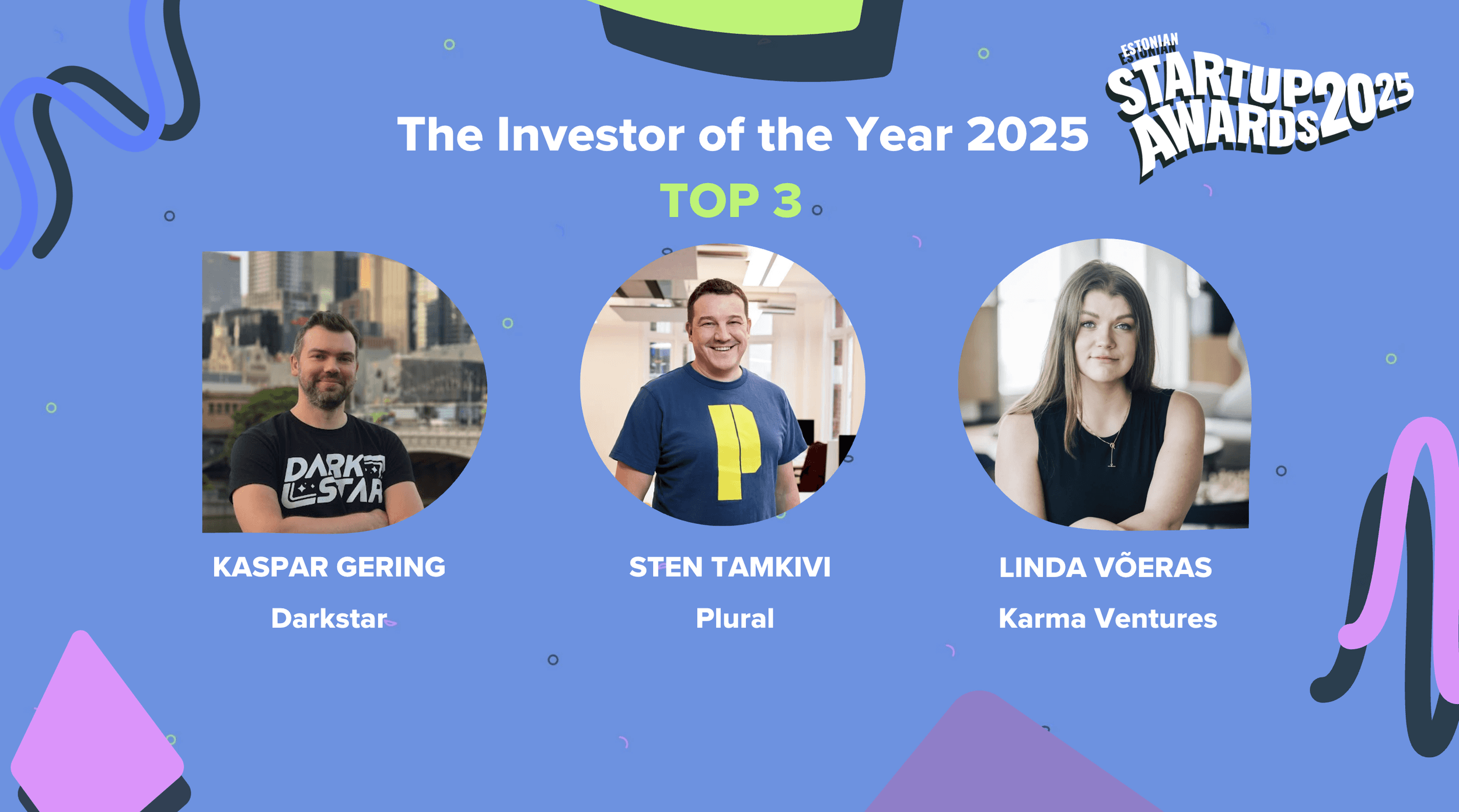
The Investor of the Year 2025 - Sten Tamkivi, Plural
The best investors are team-players, gate-openers, teachers, and bridge-builders. They give meaning to the phrase “smart money”. Their words have impact, and so do their actions. To qualify, this fund or investor should have made at least 2 startup investments in 2025.
The award was presented by Vaido Mikheim, the Head of Startup Estonia: “Margus Uudam was presenting this cateogry last year, and he said that one has to announce this cateogry in order the hold the Investor of the Year award. So this year, Karma has bigger luck with Linda already nominated. But one CAN win. And Sten from Plural is the proof.”
WINNER: Sten Tamkivi, Plural
II PLACE: Kaspar Gering, Darkstar
III PLACE: Linda Võeras, Karma
THE SHORTLIST FOR THE investor of the year 2025:
A) Aleksi Partanen - Icebreaker
In 2025, Aleksi's focus was running every extra mile necessary to support the idea-stage teams with more than just capital: "I do whatever it takes to help the founders succeed, for me this VC thing is more a continuation of my own founder times when I was building my own company back in the day". In 2025, Icebreaker launched Fund III and shifted to a Partner-only model to double down on support for early-stage teams. They back pre-revenue founders with professional capital (tickets up to €1M). In 2025, they made 9 initial investments (avg. ~€750k). Aleksi led 4 of them in Estonia, for teams such as Lutso (Andres Tuul, Sten-Erik Mägus), Crewpoint, (Marko Saul, Toomas Koost), Matagi (Aleks Koha). In addition to the latest fund, they continued to make follow-on investments in all the previous funds, which is counted in tens of transactions. For Aleksi, 2025 was one of the busiest ever, and also marked his fourth year with the family here in Tallinn ("and we love it more than ever!")
B) Herty Tammo - Startup Wise Guys / 2C Ventures
Herty Tammo started Startup Wise Guys 14 years ago and they have invested in 800+ founders so far. Investments are typically in pre seed round with €100-250K tickets SWG made 7 investments into Estonian startups in 2025, notable examples include: Esgrid, UniteSync, Yaga, etc. In 2023, Herty co-founded the Cleantech VC fund 2C Ventures, which made 4 investments in 2025, including: Jälle, Bisly, GaltTec, etc.
C) Jana Budkovskaja
Jana Budkovskaja is mainly backing impact deeptech at pre-seed/seed stage. In 2025, she led around half a million of tickets across 4 syndicate rounds and accelerator batches talling €3.278M raised. Deals to mention: SafePAS (EstBAN syndicate €150k of €700k round), BrachyDOSE (EstBAN syndicate €35k of €500k round (with the first for Estonian business angels opportunity to get the part of the Lithuanian governmental fund profit-share scheme), MarkeDroid (EstBAN syndicate €175k of €300k round), and Muun Health (€46k via Better Fund of €546k). With Beamline, she helped accelerate 12 teams under a state-backed acceleration + investment program and ran a private batch of 5 teams, mentoring founders and crowding in follow-on capital.
D) Kaspar Gering - Darkstar
From day one, Darkstar runs like a wartime VC, helping the most promising founders to win the war and rearm Europe fast. Darkstar launched the fund in July 2025 and deployed €6.4M in its first six months, into 7 companies, with the largest single ticket at €1.5M. All portfolio companies went through Darkstar Bootcamps in Ukraine; four are already operating on the frontline and three more will deploy this quarter. Estonian investments include Tempterno (air-to-air rocket launcher), Domin8 (tactical training simulator), and Farsight Vision (decision intelligence platform). Due to security considerations and founder agreements, not all investments have been publicly announced. […]
E) Linda Võeras - Karma
In 2024, Linda was a community-first, early-stage investor, spending time doing 1:1 mentoring (incl. Tehnopol), creating the Technically a Party program (500+ tickets sold, great founder and investor turnout), and running coding workshops for non-tech professionals (marketers, lawyers etc). Linda helped local startups raise beyond the Karma portfolio by consistently making intros to external funds in CEE, Nordics, UK, US etc.; also introducing and inviting the funds to local conferences, and deepening ties with the Estonian ecosystem. She supports three portfolio supervisory boards, helping with scaling, hiring, cost discipline, and fundraising, and pitched in across the portfolio leveraging her executive search background and strong network. Linda also doubles down on education: lecturing on VC at EBS and TalTech, running workshops on recruiting and team building, opening VC to wider audiences via hackathons and events (her talk on executive recruiting mistakes was the highest bookmarked in the Startup Day 2025 programme), and leading the internship program at Karma. The investment focus at Karma over the last few years has remained the same - deep tech, late seed and Series A. In 2025, they did 2 new investments into Starship Technologies and Leil Storage, and participated in the follow-on investments into Pactum and Jobbatical.
F) Markus Villig
After becoming one of the most successful founders in Estonia (and scaling around the world with Bolt, the ride-hailing and micromobility powerhouse), Markus Villig is now contributing to the local ecosystem as an investor as well: "Ideally, I'm seeking Deep Tech and Defence Tech startups, but with a good team a common AI or B2B SaaS could land on my radar". Notable investments from 2025 include Tensor AI, Sera, Lightyear, Bilt.me, Lutso, etc.
G) Mart Maasik - Nordic Science Investments
In 2025, Markus worked as a hands-on early-stage investor focused on research-empowered and deep tech companies, primarily university spinouts across the New Nordic region. Together with the Nordic Science Investments (NSI) team, they completed 9 pre-seed investments in 2025, with a focus on AI-enabled techbio and deep industrial tech, while collaborating with 12 leading universities across the region. Notable 2025 investments include PixlBio, MuRay Tech, Otos, and Sample Facts. Beyond individual companies, NSI also made a non-financial investment into developing regional best practices for research spinout development, particularly around the early transition from lab to company, supporting long-term value creation and help to unlock growth through regional collaboration.
H) Riivo Anton - Specialist VC
Riivo Anton is a founding partner at Specialist VC, a VC firm covering the Baltics and beyond. Specialist VC is a sector agnostic investor focusing on primary opportunities in pre-seed to Series A and secondary transactions into post Series A companies. In 2025, the focus was on supporting the exisiting portfolio and initiating the exit process of multiple startups. In total, Specialist VC made 35 deals in 2025, 9 of which where into new companies, and the rest were additional contributions into existing portfolio companies. About half the deals were into Estonian startups. The most significant investments in 2025 include Yaga (pre-Series A), Sera Leads (seed), Lightyear (Series B), and Vocal Image (seed).
I) Sille Pettai - SmartCap
Year 2025 was rather challenging in terms of market conditions, fundraising, deep tech deal flow and adjusting the team's mindset on the way - it required balancing focus and priorities between setting up and get going with defence investments from SmartCap Defence Fund, and keeping investment focus still on SmartCap Green Fund as its investment period is ending mid-2026. A key focus on 2025 was on ensuring they achieve €100M SmartCap Green Fund deployment target and optimal portfolio composition. Deals to highlight: Starship Technologies, Darkstar Ventures Fund I, PowerUp. In total, the team made 7 investments in funds and 12 investments in companies incl. follow-ons.
J) Sten Tamkivi - Plural / Skaala
After two decades of angel investing, Sten went full time four years ago with Plural, a €800M venture platform to back the most ambitious early stage founders to have GDP level impact on Europe (much in the way we have already done with startups in Estonia). In Plural model, each partner bets big only in a few new investments a year, and Sten's newest bet in Estonia is not yet announced... Elsewhere in Europe he has led crazy ambitious investments in autofocus eyewear, building houses with robots, software stack for total defense and mining water from asteroids. Big exit news from 2025 was selling Ready Player Me to Netflix. Besides Plural, Sten is also a partner at Skaala.
_____________
CATEGORY 8
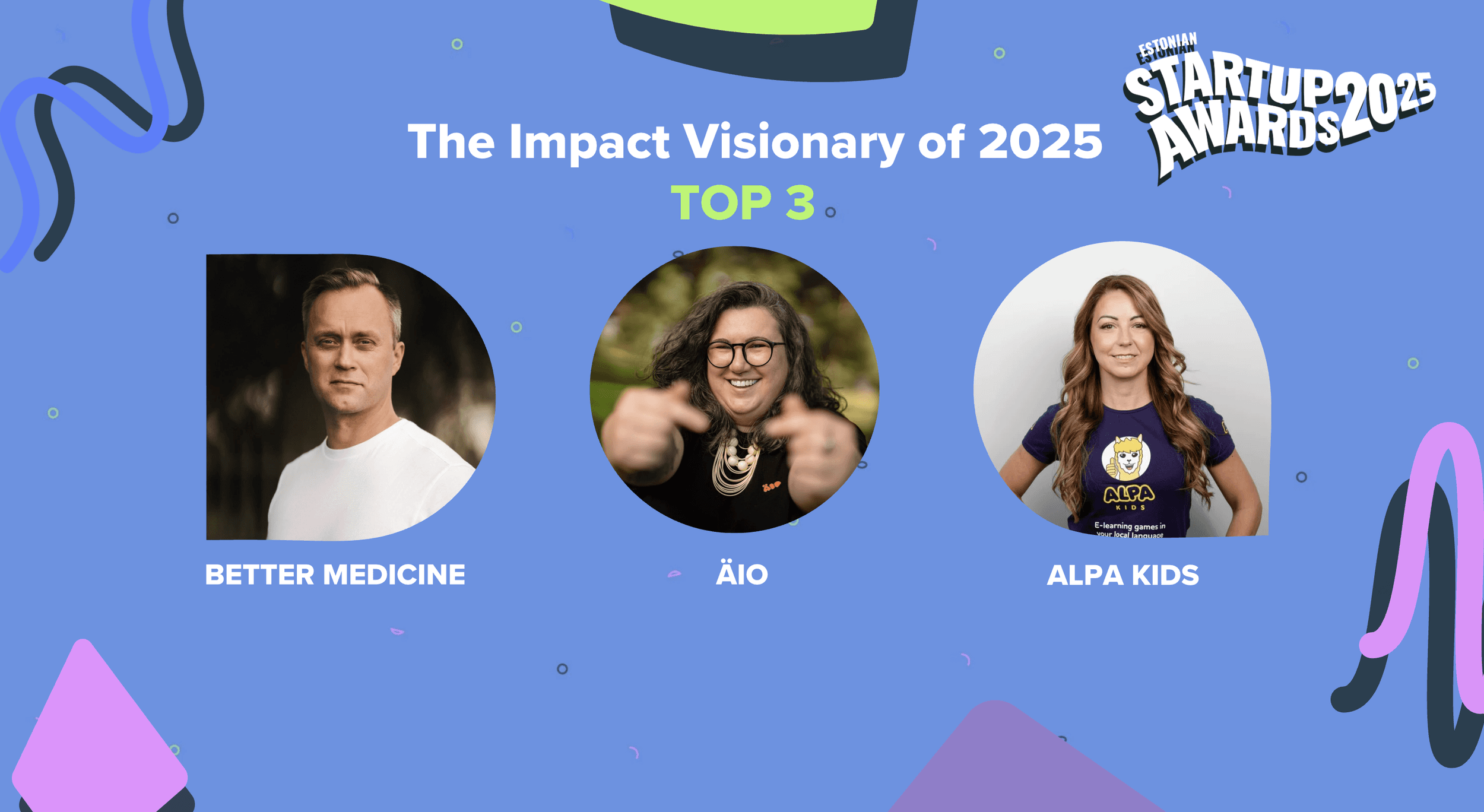
The Impact Visionary of 2025 - ALPA Kids
Startups in this category are shaping a better future. Their 2025 breakthroughs -whether in greentech, cleatnech, edtech, medtech, or beyond - deliver tangible impact, improving lives and inspiring the world to change.
The award was presented by Eva-Maria Rinkevicius, the Advisor to Deputy Mayor Kristjan Järvan in the Field of Entrepreneurship at Tallinn City: “Do you actually know how important you are to us? Small ideas grow into big ones, and Tallinn is happy to be the testing ground for those, throughout the entire growth journey. Thank you for being you, dear founders!”
WINNER: ALPA Kids
II PLACE: Better Medicine
III PLACE: ÄIO
THE SHORTLIST FOR THE impact visionary 2025:
A) ÄIO
ÄIO develops sustainable fats and oils using fermentation and organic side streams (such as sugars from sawdust) to replace palm oil, animal fats, and tropical butters in food and cosmetics. In 2025, ÄIO scaled its proprietary yeast-based process from 300L pilot scale to 10000L demo scale, prepared for 100000L scale-up and validated downstream processing. The team grew to 24, over 50% holding MSc and 23% PhD degrees. ÄIO secured R&D grants for over €2M, expanded collaboration with global partners, submitted a novel food dossier in Singapore and received several international nominations and awards. ÄIO pitched at TechCrunch Startup Battlefield and Web Summit, contributed to panel discussions at COP30, and welcomed the President of Estonia to its facilities. Personally, CEO Nemailla Bonturi led ÄIO’s transition from research spin-off to scale-up company while representing Estonia and Estonian deep tech globally.
B) ALPA Kids
ALPA Kids develops native language e-learning games that scale. Its learning impact is continuously measured and validated by dozens of MA theses and the CEO’s PhD research. In 2025, ALPA Kids published its first book, donating 15% to children’s hospitals. With EFS, ALPA Kids kickstarted Pancake Morning, a new community event tradition inspiring kids to explore technology and startups. By the end of 2025, the purpose-driven company reached globally 2.5M+ downloads and 500+ schools as clients across the Baltics and Poland. Children spent 19.8M minutes (~38 years!) learning with ALPA and the revenue grew 92%, the team 30%, and also – in Q4 ALPA Kids received €1.2M funding, with the round led by Skaala.
Better Medicine develops the world’s first clinically validated AI solution for cancer detection. The solution aims to assist radiologists in identifying cancer earlier and faster.
D) Bisly
Bisly develops scalable, AI-driven building automation to reduce energy use and CO₂ emissions across Europe. 2025 marked Bisly’s transition from a startup into a fast-growing international company under CEO Ants Vill’s leadership. The company closed a €4.3M Series A1 round, nearly doubled revenue year-over-year, and doubled its headcount, while expanding to 40+ partners across the Baltics, Nordics, Poland, DACH, and the UK. Bisly won the Mastercard Lighthouse Impact Potential Award, secured multiple R&D grants, and scaled its platform multifold, turning intelligent, low-carbon buildings into a deployable reality.
E) Jälle
Jälle solves the main pains of the battery recycling industry: low lithium recovery efficiency and the lack of viable solutions for graphite upcycling. USP = turning li-ion battery waste into high-value graphene-based materials. In 2025, they nailed the best proposal for EIS’s €1.0M RUP funding, €37k business development support, and won the €25k Climate-KIC award as well as the DefHack resilience hackathon. Within 4 months of forming the founding team (CEO Erki Ani joined in Feb 2025), they closed a €750k pre-seed round led by Kiilto Ventures and Norrsken Evolve, and 2C Ventures. They scaled lithium recovery to kg-scale at 80%+ efficiency, increased graphene-material production 25x. Filed their first patent and opened our lab with the Estonian President and the Minister of Climate and Energy. Started product testing with 3 customers and 3 suppliers from the EU. Team grew from 4 co-founders (phD Kerli Liivand, phD Reio Praats, Martin Jantson, Erki Ani) to 9 people.
F) PowerUP Energy Technologies
PowerUP Energy Technologies - a deeptech startup founded by Dr. Ivar Kruusenberg - transforms the global off-grid energy landscape by replacing diesel generators with clean, silent hydrogen generators. In a breakout year, PowerUP secured a €10M Series A to scale its hardware products, expanded its strategic distribution network 5x to cover 26 distributors across Europe, and saw its generators become battle-tested on the front lines of Ukraine - resulting in accelerated commercial adoption as it charges into a pivotal 2026.
G) SafePAS
SafePAS is an Estonian deeptech company making lab-grade analytics affordable and accessible for data-driven decisions in public safety and agri-food. In 2025, founders Jekaterina Mazina-Šinkar, Jelena Gorbatsova, Evelin Halling and Ivo Kuldmäe scaled impact-driven pilots of DrugHunter (on-site saliva drug-impairment analysis for safer roads and workplaces) and SMAGRY (data-driven farming). SafePAS secured ~€3.25M (€700k pre-seed, €2.5M EIS grant based on the EIC Seal of Excellence, €50k scale-up support), expanded its portable lab-grade expert system with new substance detection capabilities, won sTARTUp Pitching 2025, and grew to 15 employees by Q4, strengthening Estonia’s position in applied, impact-focused analytics.
Stargate Hydrogen makes green hydrogen cheap by using innovative and patented ceramic-based materials for hydrogen production via electrolysis. The world needs affordable green hydrogen in order to build resilient energy systems and decarbonize sectors that cannot be electrified. 2025 was a stand-out year for Stargate, we opened our new factory in Tallinn, raised a 15 mEUR A-round (including strategic investment from Repsol) and grew revenue more than 2x to 2.6 mEUR. We delivered out products to Europe, Asia and Middle East, including a key delivery to strategic customer in Finland - Fortum.
I) UP Catalyst
UP Catalyst turns captured CO₂ into battery-grade graphite for the €35 billion global market, replacing fossil feedstocks traditionally used to produce it. In 2025, the company moved to pilot production scale, with technical validation confirming that its CO₂-derived graphite matches leading fossil-based alternatives in performance. For its impact, UP Catalyst was recognised by the European Commission as a Strategic Project – one of just 5 graphite processing projects selected across Europe to strengthen resilience in critical materials – and was also named #1 CO₂ utilisation technology by the World Economic Forum. The company recently secured an €18M EIB loan and €47M in national support for its planned industrial facility.
_____________
CATEGORY 9
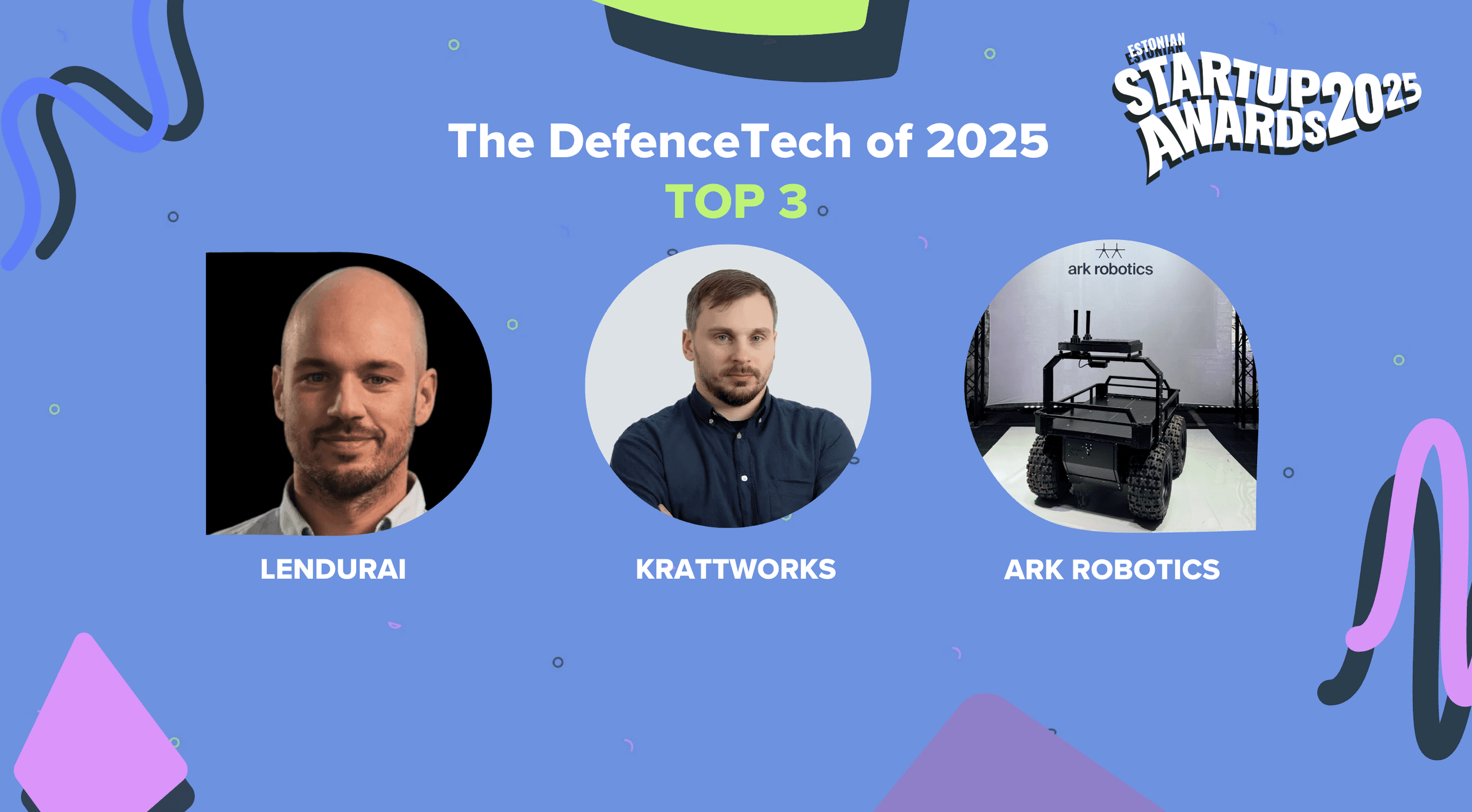
The DefenceTech of 2025 - KrattWorks
Solutions in Defence Tech, Security Tech, MilTech and Cyber Security (a special superpower of Estonians) protect and save lives. For years, this sector has been in an insane race to keep on scaling and growing when the stakes are the highest. Whose actions have been the most noteworthy in 2025?
The award was presented by Major Ivo Peets, the Commander of the Force Transformation Command at Estonian Defence Forces: “Defence sector matters and we do have to invest a lot into defence. Before I announce the winner, I want to thank you all for being in this field, for building Estonian tech. But it’s alos important to support each other, across borders, to collaborate in these troubling times; so after the troubling times are over, we can grow out of the 55% richest countries in Europe, and land among the top 80% or top 90%.”
WINNER: KrattWorks
II PLACE: Lendurai
III PLACE: Ark Robotics
THE SHORTLIST FOR THE defencetech of 2025:
A) Ark Robotics
Ark Robotics is a technology company building core infrastructure for mass autonomous robotics and collaborative autonomy. Last year, they opened their new headquarters in Estonia, doubled the team, launched production of their medium ground robot, and began development of their first aerial robot. Their products have been deployed across over 20 military units of the Armed Forces of Ukraine, procured by the Ministry of Defence of Ukraine and the Ministry of Digital Transformation.
B) C2GRID
Born out of a TalTech research laboratory just over a year ago, C2GRID is building an AI-powered 3D situational-awareness platform that turns ordinary videos into actionable operational intelligence. Development has been driven by direct feedback from Ukrainian units, ensuring frontline relevance. In 2025, C2GRID secured €520k in an oversubscribed funding round from two VC funds and one angel investor, and was selected for the NATO DIANA program. Within a year, the team advanced from prototype to pilot validation, demonstrating strong traction as a deeptech and defence-focused newcomer.
C) CrystalSpace
CrystalSpace is a deep-tech company delivering mission-critical imaging systems that power the next generation of space missions and autonomous defence platforms. In 2025, the company more than doubled its revenue and put its technology on the Moon. At the same time, CrystalSpace made strong advances in the defence and UAV markets - secured international partnerships, launched next-generation products - positioning the company for rapid growth and high-impact innovation across space and defence sectors.
Farsight Vision offers ISR data analytics and intelligence at scale to discover immediate threats. The solution facilitates the creation of digital twins on the map by processing video, photos, and streams from drones, utilizing precise geospatial analytics for situational awareness. They ensure compatibility with various drone hardware and other camera-based unmanned vehicles, while enabling near real-time detection and tracking of changes on the map.
E) HIMERA
HIMERA is a developer and manufacturer of communication systems for the Defense Forces. HIMERA’s solutions are battlefield-ready and used in Ukraine's hottest defensive and offensive operations. The US Air Force and US Special Operations Forces have validated HIMERA’s solutions.
F) KrattWorks
KrattWorks is a force multiplier delivering drones to the defence sector. In 2025, they successfully scaled their team from 22 to 68 people, secured more than €3M worth of grants, and increased their production from 100 drones per year to 120 drones per month. They expanded to 5 new markets in the EU, and secured 3 new office locations in Kyiv, Tartu and their new main HQ in Tallinn. Their revenue grew 26x - through strategic decisions and planning, they successfully ended the year with €19.7M. They face 2026 with confidence and optimism.
G) Lendurai
Lendurai develops advanced autonomy solutions that enable drones to operate without radio links or GNSS navigation, ensuring reliable performance in contested and denied environments. In 2025, the company reached several major milestones, most notably closing a €5.6M seed funding round to accelerate product development and expansion. Lendurai successfully expanded its presence in Ukraine and delivered its products to the Estonian and Ukrainian armed forces, demonstrating real-world product traction. The team also launched a partnership-based go-to-market strategy, helping to scale the deployment of its capabilities. These achievements marked a strong year of growth, validation, and execution.
H) Sky Spy
Sky Spy provides mission-critical, AI-powered SIGINT systems for contested environments, helping allied democracies achieve spectrum dominance in the era of robotic warfare. In 2025, the company raised an oversubscribed a $xx pre-seed round, reached TRL-7, and became the first EW startup of its kind to complete […] successful combat missions on the Ukrainian frontline. Sky Spy system located […] hostile emitters with ~50m accuracy and double confirmation, including jammers and UAV control stations - enabling rapid countermeasures and saving dozens of lives. Sky Spy launched integrations with 5 OEMs globally and scaled its customer pipeline across the EU and US, establishing itself as a future leader in electronic warfare.
Stratis Intelligence has created a data analysis solution that can be used for everything from planning drone missions to forecasting the weather. Stratis software analyzes complex data sets in milliseconds, allowing end users to make more informed decisions in a data-overloaded environment. The startup was founded in 2025 by Ingvar Helgason and Smári McCarthy. In 2025, Stratis raised a round of €2.25M.
J) Wayren
Wayren develops resilient communication solutions for the world’s most demanding environments, essential for situational awareness in mission-critical scenarios. In a pivotal year, Wayren transitioned from a promising technology to a fielded product, deploying its system in Estonia, Ukraine, and Scandinavia. By driving early adoption along NATO’s eastern flank, securing an €8M late-seed investment, and being selected as one of 15 companies for NATO DIANA Phase II, Wayren is positioned to address a critical capability gap across NATO and its allies.
_____________
CATEGORY 10
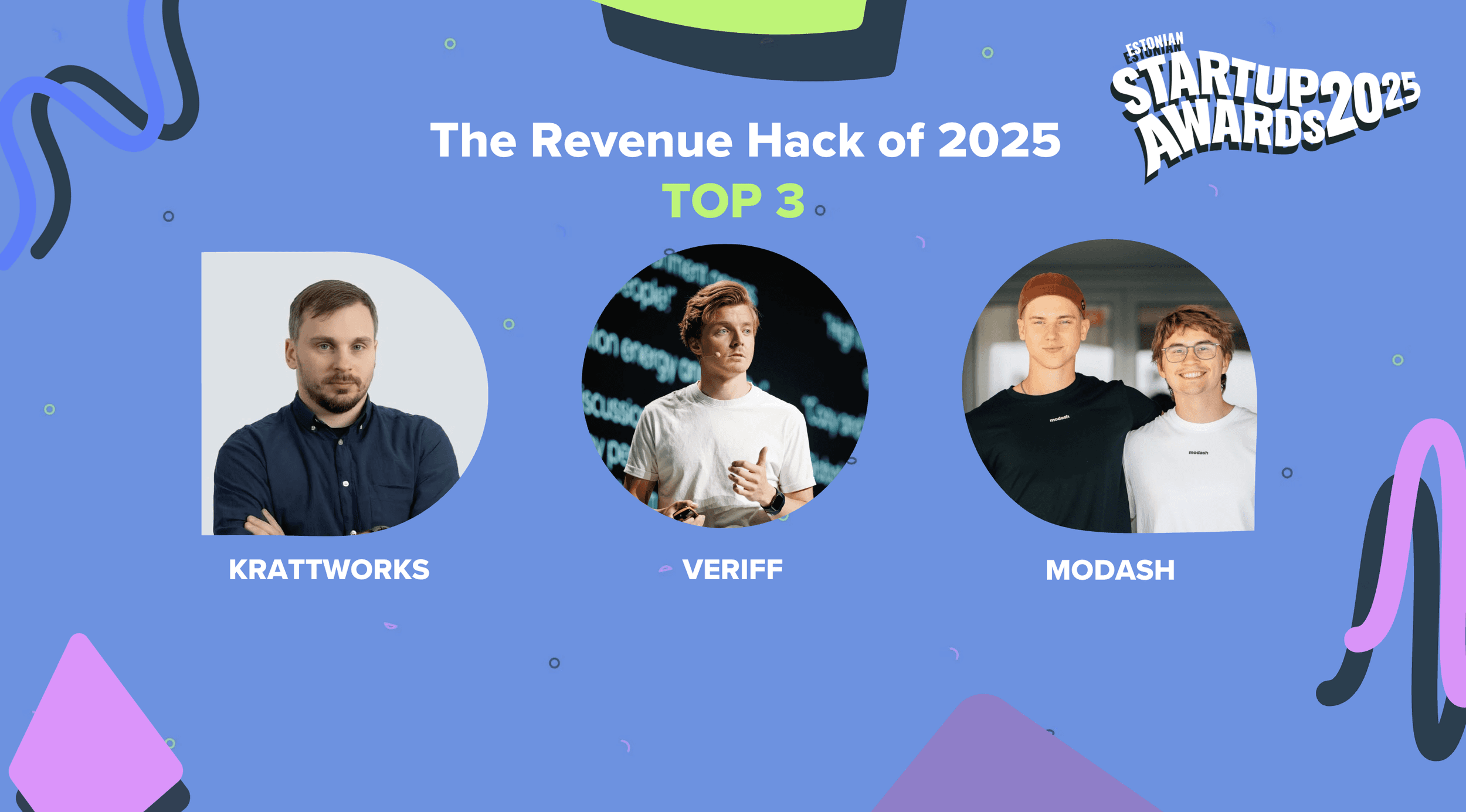
The Revenue Hack of 2025 - Veriff
In 2025, startups are still the turbo-fuelled jet packs of our economy. The sector’s turnover and tax revenue keep growing YoY. In this category, we’re not only looking for the biggest revenue-builders, but also the ones who inspired you the most - the startups with resilience and creativity to grow and make money.
The award was presented by Jevgeni Kabanov, President of Bolt: “5 years ago, Bolt was on the stage winning this category. So we were doing something right. But I was thinking of the revenue hacks: as a founder of ZeroTurnAround, back in the day, we discovered the effect of check boxes - add them everywhere, that’s my free advice of the day.”
WINNER: Veriff
II PLACE: KrattWorks
III PLACE: Modash
THE SHORTLIST FOR THE Revenue hack of 2025:
A) Blackwall
Blackwall (formerly known as BotGuard), provides a cybersecurity platform designed to protect web resources from automated threats such as malicious bots, DDoS attacks, and fraud. It works by filtering traffic at the entry point, before it reaches a client's server infrastructure, to identify and block unwanted activity in real time. The company has raised €45M. In 2025, Blackwall's revenue grew from €8.2M to €12.3M.
B) Creem
Creem is a Merchant-of-Record and financial operating system that helps small SaaS teams sell globally without dealing with payments, tax, or compliance complexity. In 2025, Creem launched its core MoR platform, automated tax handling, revenue-splitting infrastructure, and stablecoin payouts. Over the year, the company grew weekly GMV by over 17,000%, scaled total processed volume by eight figures, and increased ARR by more than 70x, with particularly strong acceleration in Q3 and Q4. In 2025 Creem closed a €1.8M pre-seed round and expanded from founders-only to a cross-functional core team in Estonia.
C) KratTrade
KratTrade is on a mission to make energy asset management profitable to mid-to-large clients and portfolio owners through scalable tech and agentic-first approach. In 2025, they successfully scaled 3 different PoC's into 1M+€ product lines; launched their second market in September; and currently are generating €2M+ in monthly value for their clients. Their combined portfolio has over 25 customers, more than 2000 devices and has delivered more than 80 000 activations to Baltic Electricity system. With their frugal approach, they have managed to deliver all of this only with 4 team members - focusing on highest impact and keeping the cost base low.
D) KrattWorks
KrattWorks is a force multiplier delivering drones to the defence sector. In 2025, they successfully scaled their team from 22 to 68 people, secured more than €3M euros worth of grants, and increased their production from 100 drones per year to 120 drones per month. They expanded to 5 new markets in the EU, and secured 3 new office locations in Kyiv, Tartu and our new main HQ in Tallinn. Their revenue grew 26 times - through strategic decisions and planning, they successfully ended the year with €19.7M. They face 2026 with confidence and optimism.
E) MarkeDroid
MarkeDroid operates across 12 European markets with an AI-based plug-and-play energy orchestration and trading platform that consistently boosts savings and earnings by up to 150%. Positioned in the global $1.2 trillion renewable energy services market, their solution creates tangible value for distributed energy resources, utilities, commercial and industrial customers and end consumers by optimizing energy flows, reducing costs, and unlocking new revenue streams. In 2025, they delivered notable milestones: 10x growth in key DER battery capacity (110 MWh), €1.4M revenue and sustained positive cash flow, with customers benefiting to the tune of €3M. They secured a €0.5M grant from RUP to advance Microgrid pilots with the DSO, supported by a 2.5x increase in headcount and a move to a larger office in December to accommodate the next growth phase. Looking ahead, their priorities are scaling DER capacity, accelerating Microgrid deployments, and deepening partnerships to unlock further value.
F) Modash
Modash helps brands like Burga, Sunday Riley, and Stanley1913 partner with content creators, boosting the growth of those brands and helping creators earn a living doing what they love. 2025 was a crazy year for Modash: they acquired Promoty, assembled their Canada team from scratch, and built a unique AI search product that helps brands find high-quality creators who are often overlooked. This drove faster growth, crossing 2,000 customers and the $10M ARR mark, all while staying efficient with a net burn of just $1M.
G) Salesforge
As a former VP Sales, Frank Sondors has built Salesforge to blend sales teams with AI agents in a single software to deliver more sales pipeline and reduce the cost of acquisition by reducing sales headcount. In 2025, they launched a mobile app, a Chrome extension and 3 new products - LinkedIn engagement, Leadsforge and Primeforge - helping their customers now deliver up to 30% reply rates and seven-figure pipelines. They opened a new office, scaled to 40+ team, 4M SEO pages and with double-digit growth have been named the top 10 European AI agent company by Sifted together with Lovable & n8n.
H) Sisu Tech
Founded by Jan Svendsen, Anders Karlsen and Yannick A. Svendsen, Sisu Group is a technology company on a mission to redefine the future of iGaming, building next-generation player experiences across multiple brands, serving the global iGaming market estimated at over €100 billion. In 2025, in just its second year of being live, Sisu Group achieved substantial international growth, reaching approximately €60M in annualized revenue and serving over 140,000 customers. The company expanded its team to 163 members, primarily located in Estonia and Spain, and relocated its Tallinn headquarters to a brand new office in the city centre.
I) Veriff
AI-native Veriff is the trust layer for the internet - to trust online, you need to Veriff. In 2025, Veriff tripled service volumes year-over-year and doubled revenue, reaching a $100M+ run rate by October '25. Veriff is growing profitably, ending the year with an 81% gross margin and a ~$10M EBITDA run rate. Their growth momentum is accelerating: it took Veriff 10 years to complete their first 400 million verifications, and now they are on track to process an additional 400 million in just five months. In March, Veriff opened a tech hub in Brazil and continued to expand across Latin America, the Middle East, Africa, and APAC, deepening its footprint in emerging markets.
J) Vocal Image
Vocal Image is an AI communication coach for personal and professional growth. In 2025, they secured a €3.2M Seed round, added 50,000+ new customers, and reached €14M ARR (2x growth in the last 6 months). They hold the industry's largest labeled dataset of 2M+ human voices and a unique analytics engine. Unlike standard LLM wrappers, Vocal Image processes raw audio signals to quantify how a speaker is perceived, making communication coaching accessible.
_____________
CATEGORY 11
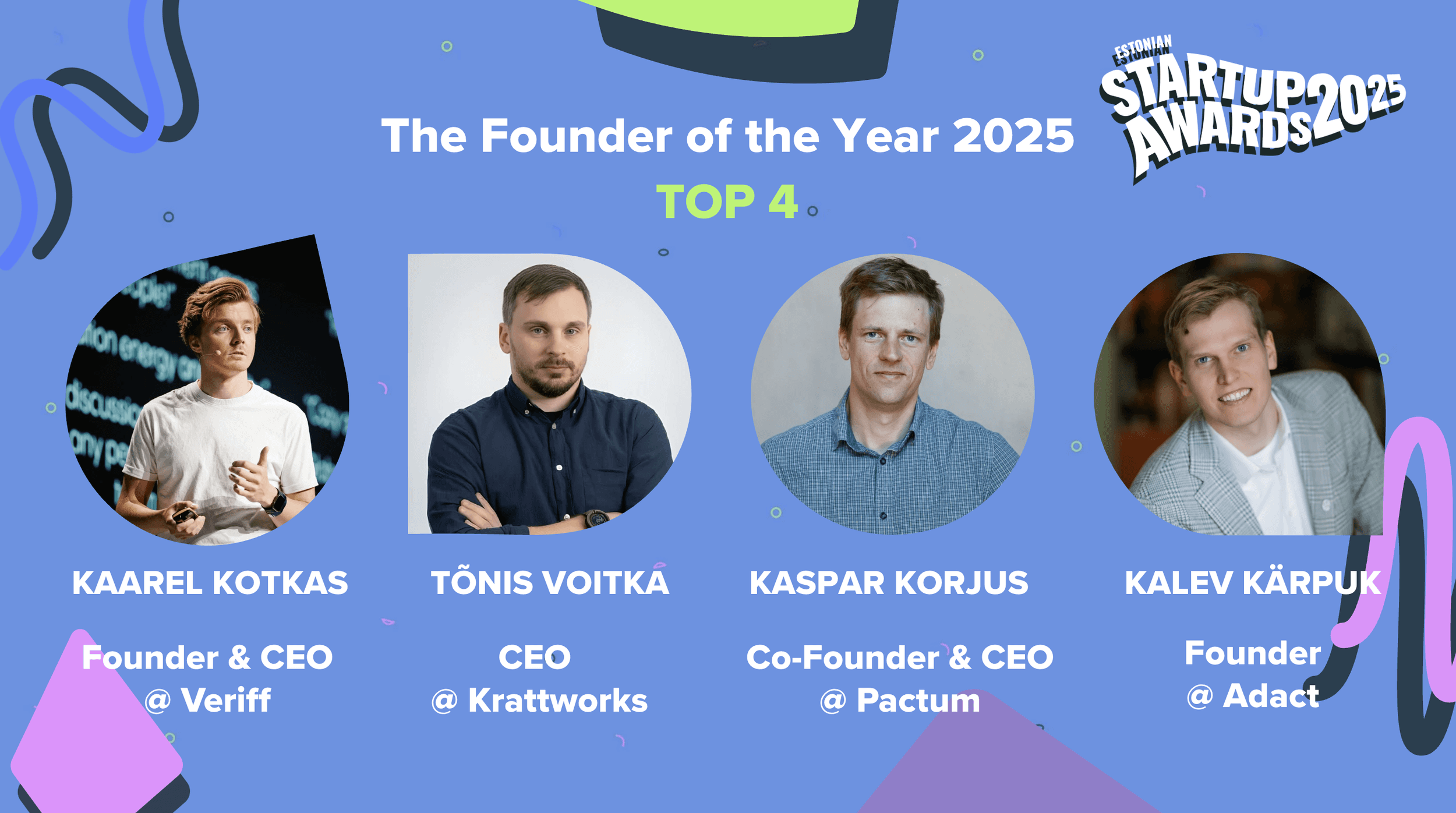
The Founder of the Year 2025 - Kaarel Kotkas - Veriff
Whatever you admire in a founder, this person fills you with awe and inspiration. Who went the extra mile? Who showed the most grit? Whose impact was the clearest? Who brought in the surprise act of the year?
The award was presented by Allan Martinson, the President of Estonian Founders Society: “Good founders launch on time, and since we are behind time, I’ll make it the quickest announcement ever - the winner is Kaarel Kotkas!”
WINNER: Kaarel Kotkas - Veriff
II PLACE: Tõnis Voitka - KrattWorks
III PLACE: Kalev Kärpuk - Adact
III PLACE: Kaspar Korjus - Pactum
THE SHORTLIST FOR THE founder of the year 2025:
A) Ahti Heinla - Starship
Starship is automating last-mile delivery with its autonomous delivery robots. While 95% of autonomous driving companies are in pilot stage, Starship solution is at commercial scale, with 2700+ robots operating today in 270+ locations in Europe and US. This is the same scale as Waymo, making Starship one of the most commercially successful autonomous driving companies in Europe (certainly the largest by commercial revenue). They have done almost 10 million deliveries to date. Their scale includes almost nation-wide coverage of Finland, where they cover 20 largest cities, and are delivering for the largest grocer and also for the largest delivery app in the country.
Bisly develops scalable, AI-driven building automation to reduce energy use and CO₂ emissions across Europe. 2025 marked Bisly’s transition from a startup into a fast-growing international company under CEO Ants Vill’s leadership. The company closed a €4.3M Series A1 round, nearly doubled revenue year-over-year, and doubled its headcount, while expanding to 40+ partners across the Baltics, Nordics, Poland, DACH, and the UK. Bisly won the Mastercard Lighthouse Impact Potential Award, secured multiple R&D grants, and scaled its platform multifold, turning intelligent, low-carbon buildings into a deployable reality.
C) Avery Schrader - Modash
Modash helps brands like Burga, Sunday Riley, and Stanley1913 partner with content creators, helping those brands grow and helping creators earn a living doing what they love. 2025 was a crazy year for Modash: they acquired Promoty, assembled their Canada team from scratch, and built a unique AI search product that helps brands find high-quality creators who are often overlooked. This drove faster growth, crossing 2,000 customers and the $10M ARR mark, all while staying efficient with a net burn of just $1M.
D) Hedi Mardisoo - Cachet
Hedi Mardisoo, CEO & Co-Founder of Cachet, Cachet is building the insurance infrastructure for Europe's platform economy. In 2025, Cachet delivered its first EBITDA-positive year, achieved 2,5x year-on-year growth, and scaled operations across 16 European markets, while becoming the market leader in the shared mobility coverage provider across the Nordics and Baltics. These milestones were reached while sustainable growing the team and partnering up with the leading Insurers in the EU. Beyond Cachet, Hedi serves on the board of the Estonian Founders Society and represents Estonian founders in key EU policy forums. From the Single Market to Europe's Start-Up Strategy, she was a driving force in Brussels, leading Estonia's ecosystem through the year's most strategic conversations.
E) Ivar Kruusenberg - PowerUP Energy Technologies
Founder Dr. Ivar Kruusenberg leads PowerUP Energy Technologies, a deeptech startup transforming the global off-grid energy landscape by replacing diesel generators with clean, silent hydrogen generators. In a breakout year, PowerUP secured a €10 million Series A to scale its hardware products, expanded its strategic distribution network 5x to cover 26 distributors across Europe, and saw its generators become battle-tested on the front lines of Ukraine - resulting in accelerated commercial adoption as it charges into a pivotal 2026.
F) Kaarel Kotkas - Veriff
AI-native Veriff is the trust layer for the internet - to trust online, you need to Veriff. In 2025, Veriff tripled service volumes year-over-year and doubled revenue, reaching a $100M+ run rate by October '25. Veriff is growing profitably, ending the year with an 81% gross margin and a ~$10M EBITDA run rate. Their growth momentum is accelerating: it took Veriff 10 years to complete their first 400 million verifications, and now they are on track to process an additional 400 million in just five months. In March, Veriff opened a tech hub in Brazil and continued to expand across Latin America, the Middle East, Africa, and APAC, deepening its footprint in emerging markets.
G) Kalev Kärpuk - Adact
Adact was a gamification marketing software that Kalev built from a single PowerPoint slide in 2020 into € […] exit in 2025. Across two investment rounds, they retained 70%+ ownership and exited at an exceptional […] ARR multiple valuation becoming one of the few 8-figure exits in Estonian startup history. In just five years, Adact maintained 100% year-over-year growth, expanded to 200+ clients across 14 countries with capital efficiency and disciplined growth. At exit, the entire company was run by a team of three. As a first-time solo-founder, navigating product, sales, fundraising, and exit carries proof that the “Founders Dream” is real: anyone can start from zero and arrive to life changing outcomes by creating a startup in Estonia.
H) Kaspar Korjus - Pactum
Pactum AI builds autonomous negotiation agents that negotiate deals at scale for the world’s largest enterprises. In 2025, they doubled the customer base, adding BMW, Rolls-Royce, AstraZeneca, Nestlé and UPS amongst others; raised Estonia’s largest round - $54M led by Insight Partners; grew the team from 99 to 155; surpassed the magical $10M ARR; while the agents negotiated 4x more $$$ than in the first five years combined. In addition to building Pactum, Kaspar is a committed contributor to the wider entrepreneurial ecosystem, having led e-Residency program or initiatives like VibeCoding with Lovable.
I) Nemailla Bonturi - ÄIO
ÄIO develops sustainable fats and oils using fermentation process and organic side streams, such as sugars from sawdust, to replace palm oil, animal fats, and tropical butters in food and cosmetics. In 2025, ÄIO scaled its proprietary yeast-based process from 300L pilot scale to 10000L demo scale, prepared for 100000L scale-up and validated downstream processing. The team grew to 24 people, over 50% holding MSc and 23% PhD degrees. ÄIO secured R&D grants for over €2M, expanded collaboration with global partners, submitted a novel food dossier in Singapore and received several international nominations and awards. ÄIO pitched at TechCrunch Startup Battlefield and Web Summit. As founder and CEO, Nemailla led ÄIO's transition from a research spin-off to a scaling deeptech company while representing Estonian innovation globally. In 2025, she spoke on a panel at COP30 in Belém, welcomed the President of Estonia to ÄIO's facilities, and was honored with the Distinguished Alumni Award 2024 by UNICAMP.
J) Tõnis Voitka - KrattWorks
KrattWorks is a force multiplier delivering drones to the defence sector. In 2025, they successfully scaled their team from 22 to 68 people, secured more than €3M euros worth of grants and increased our production from 100 drones per year to 120 drones per month. They expanded to 5 new markets in the EU, and secured 3 new office locations in Kyiv, Tartu and our new main HQ in Tallinn. Their revenue grew 26 times - through strategic decisions and planning, they successfully ended the year with €19.7M, and face 2026 with confidence and optimism.
Estonian Startup Awards 2025 was co-organized by LIFT99, Estonian Founders Society, and Startup Estonia (funded by the European Union). We are immensly grateful for the headlining sponsors and their contribution on all fronts of the organizational process: Bolt, Swedbank Estonia, Estonian Ministry of Defence, City of Tallinn and PayPal.
#EstonianStartupAwards 2025 - our community’s biggest celebration of the year - would not have been possible without the ecosystem builders and activists who have backed up the cause. Thank you for fueling the initiative: Advizo, Coop Pank, Darkstar, Ellex Raidla, EIS, European Women in VC, GoWorkaBit, Hedman, Icebreaker.vc, Karma VC, Nordic Ninja VC, Plural VC, Punch Club, SkipEat, Slava Käsi OÜ, Sorainen, Specialist VC, TalentHub, Tallinn Dolls, Trind Ventures, and Viive Sünnipäev OÜ.
That’s it! Cograts to all the winners! A final heartfelt thank you to everyone who were a part of the show, who cheered for the nominees, and who keep on working towards making the Estonian startup community the best in the world! You are our rockstars!
See you in January 2027! In the meanwhile, keep an eye on our Linkedin to stay in touch!